fullseye
tb_specular_diffuse_split — 2D typed op
- データ種:
rgbimage→rgbimage - 呼び出し:
fullseye.apply(img, "tb_specular_diffuse_split", a=0.5, b=0.5)(2-D は 1 画像 + 2 スカラつまみa,b∈[0,1]のモデル)
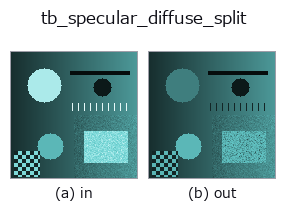
図は合成の入力 128×128 で実際に走らせた出力。左が入力、右が出力。点群は上から見た散布(明るさ = z)、1-D 列は折れ線、体積は z 方向の最大値投影、動画は中央フレーム、複素画像は振幅、絵にならない返り値は値そのもの。
つまみ a は出力を変えない(実測: 0.1 / 0.5 / 0.9 で同一)。
つまみ b は出力を変えない(実測: 0.1 / 0.5 / 0.9 で同一)。
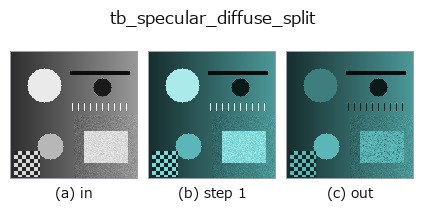
段階(前置きの op → この op。左から順):
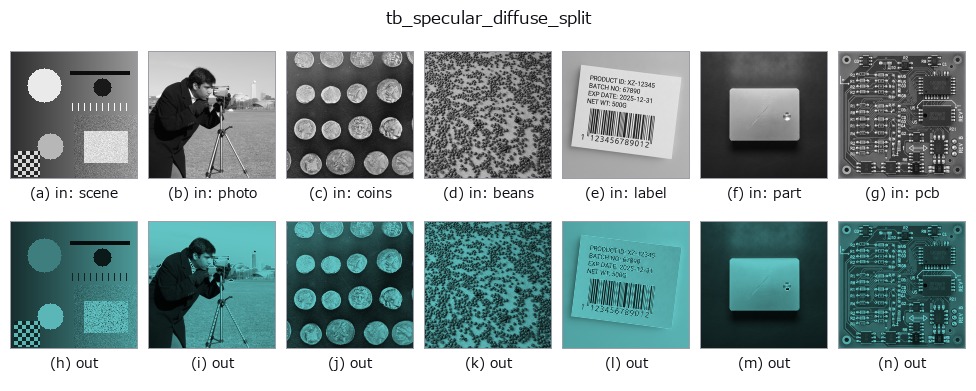
別の画像でも(合成シーン / 写真 / 硬貨。上段が入力、下段がその出力。つまみは既定):
使い方
Split a linear-RGB image into its diffuse (body) and specular (interface) parts. → (diffuse, specular), both (H, W, 3).
Shafer's dichromatic reflection model writes the radiance of a dielectric as
``I(x) = m_d(x) * L(x) + m_s(x) * G``: a body term carrying the surface
colour ``L`` and an interface term carrying the **illuminant** colour ``G``.
The specular part therefore occupies a single direction in RGB, and
separating it is a projection with a closed form — no iteration, no
optimisation, no learned prior.

Two regimes, chosen by *body_rgb*:

* **``body_rgb`` given** — a ``(3,)`` colour or an ``(H, W, 3)`` map. Each
  pixel solves the 3-equation, 2-unknown least-squares system exactly. This
  is the textured-surface path: on a synthetic image built from a known
  ``(m_d, m_s)`` it returns them with a maximum absolute error of 4.0e-15
  for a uniform body colour and 2.9e-15 for a per-pixel colour map
  (measured in ``tests/test_specularity.py``).
* **``body_rgb`` omitted** — one material is assumed. The
  illuminant-orthogonal part of the image is then exactly rank one, so the
  body direction is its leading singular vector; the unobservable component
  of ``L`` along ``G`` is fixed by requiring ``m_s >= 0`` with the minimum
  over the image equal to zero. Maximum absolute error 5.0e-16 on the same
  synthetic image. **At least one lit pixel must be specular-free** — see
  below, this is the assumption that actually bites.

*illuminant_rgb* is a **direction**; only its orientation matters and it is
unit-normalised internally. ``(1, 1, 1)`` is the white-balanced case. Get it
from :func:`illuminant_from_dichromatic_planes` when you have two or more
materials in frame.

Two guards protect the uniform-body path, and **both are needed** — the
adversarial pass found the first one alone lets a two-material image
through:

* *max_rank_ratio* — the second singular value of the illuminant-orthogonal
  part over the first. Measured on the synthetic bump: 4.6e-16 noiseless,
  0.0175 at 0.5% Gaussian noise, 0.0348 at 1%, 0.0694 at 2%, 0.173 at 5%;
  a two-material image with cyclically permuted albedos gives 0.574. The
  default 0.1 sits between the 2% and 5% noise measurements. ``None``
  disables it.
* *max_negative_frac* — the fraction of pixels whose fitted body
  coefficient comes out negative, which cannot happen for one material.
  This is what catches the case the rank test misses: two albedos whose
  illuminant-orthogonal chromaticities are nearly anti-parallel still span
  one line, and that image measured 0.0815 on the rank test — under the
  default threshold, i.e. accepted — while 50% of its pixels fit a negative
  body coefficient. With both guards disabled that image returns a diffuse
  map wrong by 1.03 in absolute radiance on an image whose maximum is 0.99,
  with no exception and no NaN. ``None`` disables it.

**Both guards bound gross violations only, and that is not fixable by a
better threshold.** A texture whose chromaticity drifts *along* the body
direction rather than away from it measured a rank ratio of 0.0641 — under
the default — with every body coefficient positive, so neither guard fires,
and the returned diffuse map was wrong by 0.198. It cannot be separated from
noise by any threshold, because it is the same measurement: 1% Gaussian
noise on that scene gives 0.0348 and 2% gives 0.0694, and the texture sits
between them. The answer for a surface that might be textured is
``body_rgb``, not a cleverer number here.

**Honest limits.** (1) *Without ``body_rgb``, one lit pixel must be
specular-free.* The rendered-lobe measurement shows exactly what it costs
when none is: for a Blinn-Phong highlight on a Gaussian bump the maximum
diffuse error is 6.5e-11 at shininess 200 (where the lobe tail underflows to
9.1e-11), 0.0019 at shininess 48 (tail 0.0026) and 0.175 at shininess 8
(tail 0.243) — the error *is* the darkest highlight in the frame, because
that is the constant the constraint cannot see. (2) *The known-body path is
conditioned by ``1/(1 - b^2)`` where ``b`` is the cosine between the body
and illuminant colours.* A texture reaching ``|b| = 0.99999`` (an almost
neutral grey under a white lamp, amplification 6.4e+04) measured 5.9e-12
against 2.9e-15 for the same texture kept at ``|b| <= 0.965``. Near-grey
surfaces are where colour-based separation is weakest, and no amount of
arithmetic care changes that.

**Raises** ``ValueError``: *image_rgb* is not ``(H, W, 3)``, is complex /
masked / non-finite / string-typed, or exceeds :data:`MAX_PIXELS`;
*illuminant_rgb* is not a non-zero 3-vector; the image is identically zero;
the image has no component orthogonal to the illuminant (body colour
parallel to it, so no split exists); either guard above fires; *body_rgb*
has the wrong shape, a zero-length colour, or is parallel to the
illuminant.

Returns ``(diffuse, specular)`` with ``diffuse + specular == image_rgb`` to
machine precision in both regimes: measured 1.1e-16 on the uniform-body
route, which forms the diffuse as ``image - specular``, and 2.1e-15 on the
known-body route, which forms both parts from the solved coefficients and
so accumulates a little more.
Typed bridge of the specular op specular_diffuse_split into the 2-D evolution registry: the same implementation, called under the op(v, a, b) convention. a drives max_rank_ratio (default 0.1) and b drives max_negative_frac (default 0.02).
参考(サンプルデータ・文献)
- サンプルデータ カタログ(DL URL / ライセンス) — 2-D は skimage.data(BSD/public)+ 合成、3-D は実データ源(Stanford/PDS 等)の DL URL。
- 演算子の来歴・参考文献 — この op 族の元になった研究/手法の出典。
Studio で試す
下のプログラムは実際に走ることを確かめてある(図と同じ入力)。Studio のヘルプではこのブロックがボタンになり、その場で読み込んで実行できる。
img_to_rgb 0.50 0.50
tb_specular_diffuse_split 0.50 0.50
実行できる例(この op を実際に呼ぶ検証済みサンプル)
次の例は元の台帳 op specular_diffuse_split を呼ぶもの。この橋渡し op は同じ実装を fn(v, a, b) 規約に合わせただけなので、挙動はそのまま当てはまる(呼び出し形だけ違う)。
- specular_photometric —
py -3.11 examples/specular_photometric.py
型が繋がる次の op(rgbimage を入力に取れる)
identity · tb_wetness · tb_sensor_capture · tb_specular_coefficient_map · tb_specular_free_transform · tb_rgb_to_quaternion
同カテゴリ(typed)
tb_points_to_voxel · tb_estimate_point_normals · tb_iss_keypoints · tb_project_points · tb_render_point_depth · tb_statistical_outlier_removal · tb_radius_outlier_removal · tb_voxel_grid_downsample
Provenance: ops.py — 2D operator registry. この per-op ノートは tools/opdocs.py md が自動生成(手編集しない)。
© 2026 Kazufumi Furuse — Fullseye operator documentation. Licensed under Apache-2.0.