fullseye
tb_lf_epi — 2D typed op
- データ種:
lightfield→image - 呼び出し:
fullseye.apply(img, "tb_lf_epi", a=0.5, b=0.5)(2-D は 1 画像 + 2 スカラつまみa,b∈[0,1]のモデル)

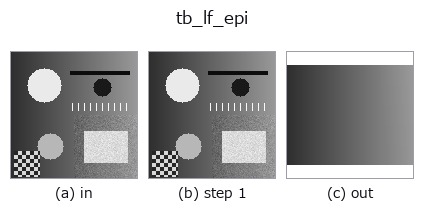
図は合成の入力 128×128 で実際に走らせた出力。左が入力、右が出力。点群は上から見た散布(明るさ = z)、1-D 列は折れ線、体積は z 方向の最大値投影、動画は中央フレーム、複素画像は振幅、絵にならない返り値は値そのもの。
つまみ a は出力を変えない(実測: 0.1 / 0.5 / 0.9 で同一)。
つまみ b は出力を変えない(実測: 0.1 / 0.5 / 0.9 で同一)。
段階(前置きの op → この op。左から順):
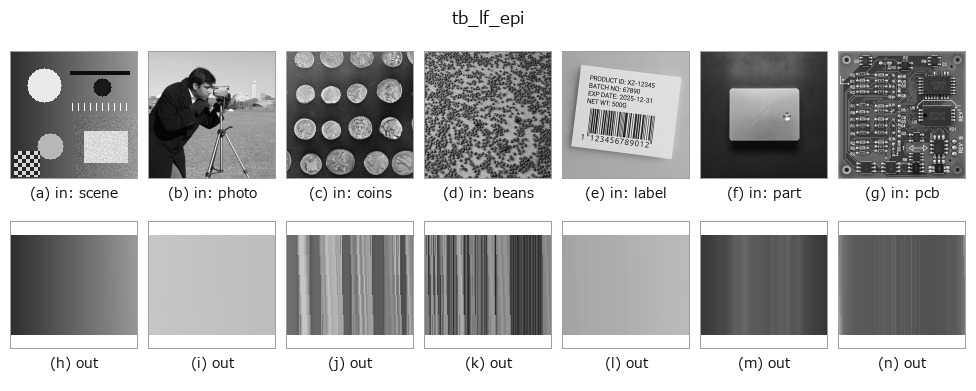
別の画像でも(合成シーン / 写真 / 硬貨。上段が入力、下段がその出力。つまみは既定):
使い方
Epipolar-plane image — the slice whose line slope is the disparity.
An EPI is what makes a light field different from a pile of photographs: fix
one image row and one angular row, and every scene point traces a *straight
line* whose gradient ``dx/du`` is exactly its slope ``s``. Occlusion becomes
one line crossing in front of another, which is why EPI methods handle it
better than window matching.

  * ``axis="u"`` (horizontal): fix ``v = view`` (default: the centre row,
    ``(V-1)//2``) and image row ``y = index``; returns ``E[u, x]`` of shape
    ``(U, W)``.
  * ``axis="v"`` (vertical): fix ``u = view`` and image column ``x = index``;
    returns ``E[v, y]`` of shape ``(V, H)``.

**Raises** ``ValueError``: *lf* not a valid light field, unknown *axis*,
*index* outside the spatial extent, *view* outside the angular extent.
Typed bridge of the lightfield op lf_epi into the 2-D evolution registry: the same implementation, called under the op(v, a, b) convention. This op has no tunable parameter; a and b are unused.
参考(サンプルデータ・文献)
- サンプルデータ カタログ(DL URL / ライセンス) — 2-D は skimage.data(BSD/public)+ 合成、3-D は実データ源(Stanford/PDS 等)の DL URL。
- 演算子の来歴・参考文献 — この op 族の元になった研究/手法の出典。
Studio で試す
下のプログラムは実際に走ることを確かめてある(図と同じ入力)。Studio のヘルプではこのブロックがボタンになり、その場で読み込んで実行できる。
img_to_lightfield 0.50 0.50
tb_lf_epi 0.50 0.50
実行できる例(この op を実際に呼ぶ検証済みサンプル)
次の例は元の台帳 op lf_epi を呼ぶもの。この橋渡し op は同じ実装を fn(v, a, b) 規約に合わせただけなので、挙動はそのまま当てはまる(呼び出し形だけ違う)。
- lightfield_depth —
py -3.11 examples/lightfield_depth.py - poc_lightfield_depth —
py -3.11 examples/poc_lightfield_depth.py
型が繋がる次の op(image を入力に取れる)
identity · gaussian · mean_box · bilateral · unsharp · median · min_filter · max_filter
同カテゴリ(typed)
tb_points_to_voxel · tb_estimate_point_normals · tb_iss_keypoints · tb_project_points · tb_render_point_depth · tb_statistical_outlier_removal · tb_radius_outlier_removal · tb_voxel_grid_downsample
Provenance: ops.py — 2D operator registry. この per-op ノートは tools/opdocs.py md が自動生成(手編集しない)。
© 2026 Kazufumi Furuse — Fullseye operator documentation. Licensed under Apache-2.0.