fullseye
tb_zero_crossing_rate — 2D typed op
- データ種:
signal→feature - 呼び出し:
fullseye.apply(img, "tb_zero_crossing_rate", a=0.5, b=0.5)(2-D は 1 画像 + 2 スカラつまみa,b∈[0,1]のモデル)
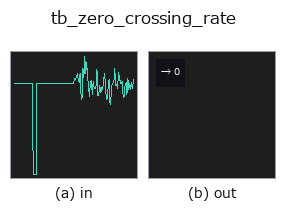
図は合成の入力 128×128 で実際に走らせた出力。左が入力、右が出力。点群は上から見た散布(明るさ = z)、1-D 列は折れ線、体積は z 方向の最大値投影、動画は中央フレーム、複素画像は振幅、絵にならない返り値は値そのもの。
つまみ a は出力を変えない(実測: 0.1 / 0.5 / 0.9 で同一)。
つまみ b は出力を変えない(実測: 0.1 / 0.5 / 0.9 で同一)。
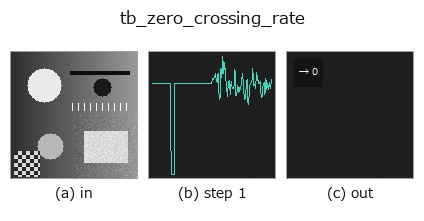
段階(前置きの op → この op。左から順):
使い方
Fraction of adjacent samples that change sign — a cheap pitch/noisiness cue.
Exact zeros are neither a crossing nor a sign: a crossing is counted only when
the sign changes between consecutive non-zero samples, and the rate divides
by the number of adjacent sample pairs len(x) - 1. So [1, 0, 1, 0, 1] is
0.0 and [1, 0, -1] is 0.5 (before 2026-09-02 diff(sign(x)) counted
every touch of zero as a crossing: 1.0 for both).
Empty input (x with 0 elements) raises ValueError.
Typed bridge of the 1d op zero_crossing_rate into the 2-D evolution registry: the same implementation, called under the op(v, a, b) convention. This op has no tunable parameter; a and b are unused.
参考(サンプルデータ・文献)
- サンプルデータ カタログ(DL URL / ライセンス) — 2-D は skimage.data(BSD/public)+ 合成、3-D は実データ源(Stanford/PDS 等)の DL URL。
- 演算子の来歴・参考文献 — この op 族の元になった研究/手法の出典。
Studio で試す
下のプログラムは実際に走ることを確かめてある(図と同じ入力)。Studio のヘルプではこのブロックがボタンになり、その場で読み込んで実行できる。
img_to_signal 0.50 0.50
tb_zero_crossing_rate 0.50 0.50
実行できる例(この op を実際に呼ぶ検証済みサンプル)
次の例は元の台帳 op zero_crossing_rate を呼ぶもの。この橋渡し op は同じ実装を fn(v, a, b) 規約に合わせただけなので、挙動はそのまま当てはまる(呼び出し形だけ違う)。
- gallery_oned_audio_funct —
py -3.11 examples/gallery_oned_audio_funct.py - gallery_spectrum_signal_bridge —
py -3.11 examples/gallery_spectrum_signal_bridge.py
型が繋がる次の op(feature を入力に取れる)
同カテゴリ(typed)
tb_points_to_voxel · tb_estimate_point_normals · tb_iss_keypoints · tb_project_points · tb_render_point_depth · tb_points_render · tb_statistical_outlier_removal · tb_radius_outlier_removal
Provenance: ops.py — 2D operator registry. この per-op ノートは tools/opdocs.py md が自動生成(手編集しない)。
© 2026 Kazufumi Furuse — Fullseye operator documentation. Licensed under Apache-2.0.