fullseye
tb_equivalent_level — 2D typed op
- データ種:
signal→feature - 呼び出し:
fullseye.apply(img, "tb_equivalent_level", a=0.5, b=0.5)(2-D は 1 画像 + 2 スカラつまみa,b∈[0,1]のモデル)
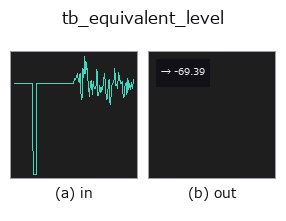
図は合成の入力 128×128 で実際に走らせた出力。左が入力、右が出力。点群は上から見た散布(明るさ = z)、1-D 列は折れ線、体積は z 方向の最大値投影、動画は中央フレーム、複素画像は振幅、絵にならない返り値は値そのもの。
つまみ a を振る(0.1 / 0.5 / 0.9、もう一方は既定):
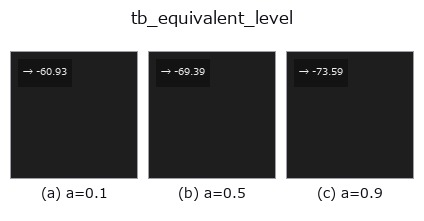
つまみ b は出力を変えない(実測: 0.1 / 0.5 / 0.9 で同一)。
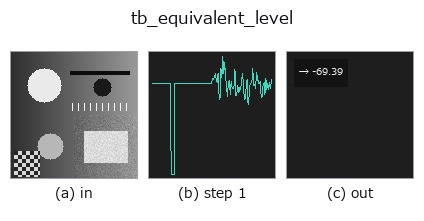
段階(前置きの op → この op。左から順):
使い方
The energy-equivalent level of a record, in dB relative to ref.
``L_eq = 10 log10(mean(x_w**2) / ref**2)`` where ``x_w`` is the signal after
the chosen weighting. Returns a plain float.

**The reference is yours to supply.** The default ``ref=1.0`` means dB
relative to one unit of the signal's own units; it is not dB SPL, because
this library never sees your calibration. Pass ``ref=20e-6`` for pascals.

Measured: a 1 kHz sine of amplitude 1.0 at 16 kHz over exactly 1000 periods
gives ``L_eq = -3.010300`` dB with Z weighting, against the closed form
``10*log10(1/2) = -3.010300`` (difference 2.2e-15 dB), and the **same** value
under A weighting (difference 8.9e-16 dB), because A is 0 dB at 1 kHz.
Doubling the amplitude adds 6.020600 dB. Silence returns -200.0.

Silence returns ``floor_db`` (default -200) rather than ``-inf``; an ``-inf``
in a list of levels destroys every average taken over it afterwards.

**A weighted level is only as good as the weighting, and the weighting has a
leakage limit this operator inherits in full.** A pure tone that is not a
whole number of periods in the record comes back **too loud** — measured
**+7.7986 dB** at 31.5 Hz (a nominal one-third-octave centre) over 0.5 s at
48 kHz, and up to **+17.2116 dB** at 20.5 Hz — with no exception, no NaN and
no warning. ``weighting="Z"`` is exempt (it does no filtering) and ``"C"`` is
nearly so (+0.0493 dB on the same tone); it is ``"A"``, whose curve spans
about 40 dB across the audio band, that is exposed.

``window="hann"`` is the opt-in remedy: the record is multiplied by a Hann
window and the mean square divided by the window's own mean square, which
suppresses the leakage almost entirely — the 31.5 Hz error goes from
**+7.7986** to **+0.0534** dB and the 20.5 Hz error from **+17.2116** to
**+0.1841** — while costing about **0.15 dB** on records that were exact
before. It is **not** the default, and must not be used when a transient's
level is the point: a window makes the answer depend on *where in the
record the sound happened*. Measured on a 50 ms burst inside a 0.5 s record
(Z weighting, so only the window acts; unwindowed all three are -13.0103 dB
as they must be): at the start **-36.0587**, at the centre **-8.8218**, at
the end **-36.0587** — a 27 dB spread produced by nothing but position.
Use ``"hann"`` for a stationary tonal record, which is exactly the case the
leakage ruins, and ``"none"`` (the default, an honest energy average) for
everything else. The full measurement is in :func:`apply_weighting`.

**Raises** ``ValueError``: everything :func:`_as_signal` refuses, an unknown
``weighting`` or ``window``, ``ref <= 0`` (a decibel needs a positive reference; a zero
reference makes every level ``+inf`` and a negative one makes the ratio
negative), ``rate <= 0``.
Typed bridge of the acoustics op equivalent_level into the 2-D evolution registry: the same implementation, called under the op(v, a, b) convention. a drives ref (default 1); b is unused.
参考(サンプルデータ・文献)
- サンプルデータ カタログ(DL URL / ライセンス) — 2-D は skimage.data(BSD/public)+ 合成、3-D は実データ源(Stanford/PDS 等)の DL URL。
- 演算子の来歴・参考文献 — この op 族の元になった研究/手法の出典。
Studio で試す
下のプログラムは実際に走ることを確かめてある(図と同じ入力)。Studio のヘルプではこのブロックがボタンになり、その場で読み込んで実行できる。
img_to_signal 0.50 0.50
tb_equivalent_level 0.50 0.50
実行できる例(この op を実際に呼ぶ検証済みサンプル)
次の例は元の台帳 op equivalent_level を呼ぶもの。この橋渡し op は同じ実装を fn(v, a, b) 規約に合わせただけなので、挙動はそのまま当てはまる(呼び出し形だけ違う)。
- acoustic_condition_monitoring —
py -3.11 examples/acoustic_condition_monitoring.py
型が繋がる次の op(feature を入力に取れる)
同カテゴリ(typed)
tb_points_to_voxel · tb_estimate_point_normals · tb_iss_keypoints · tb_project_points · tb_render_point_depth · tb_statistical_outlier_removal · tb_radius_outlier_removal · tb_voxel_grid_downsample
Provenance: ops.py — 2D operator registry. この per-op ノートは tools/opdocs.py md が自動生成(手編集しない)。
© 2026 Kazufumi Furuse — Fullseye operator documentation. Licensed under Apache-2.0.