fullseye
f2_shock_diffuse — 2D edges op
- データ種:
image→image - 呼び出し:
fullseye.apply(img, "f2_shock_diffuse", a=0.5, b=0.5)(2-D は 1 画像 + 2 スカラつまみa,b∈[0,1]のモデル)
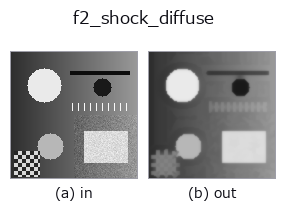
図は合成の入力 128×128 で実際に走らせた出力。左が入力、右が出力。点群は上から見た散布(明るさ = z)、1-D 列は折れ線、体積は z 方向の最大値投影、動画は中央フレーム、複素画像は振幅、絵にならない返り値は値そのもの。
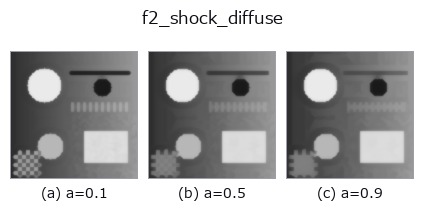
つまみ a を振る(0.1 / 0.5 / 0.9、もう一方は既定):
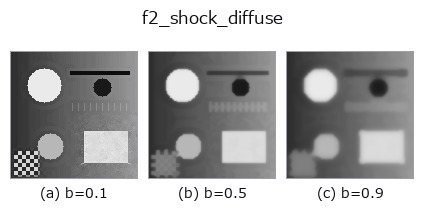
つまみ b を振る(0.1 / 0.5 / 0.9、もう一方は既定):
別の画像でも(合成シーン / 写真 / 硬貨。上段が入力、下段がその出力。つまみは既定):
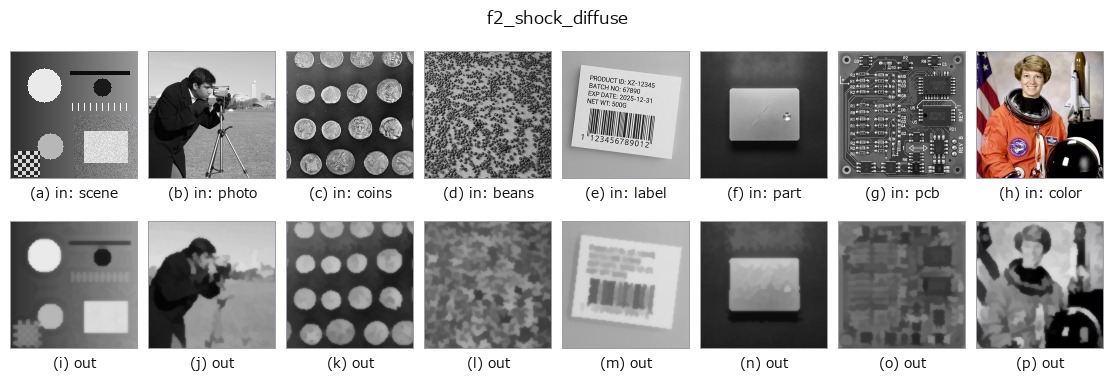
4 列目はカラー (H,W,3) の入力。この op は色を跨がずに扱える(色チャネルを 3 本目の空間軸として畳み込まない)。
使い方
Regularised shock filter: diffuse, then shock, repeated (Alvarez-Mazorra).
f2_shock is the pure Osher-Rudin shock — contraction only. It takes the
sign of the Laplacian of the raw image, so every noise bump is a zero crossing
and becomes its own shock: on a blurred edge with sigma 0.02 noise it raises
the flat-area noise from 0.020 to 0.050 (2.5x) and pushes the edge step to
0.539 — past the true step of 0.500, which is the noise being promoted to
structure rather than the edge being recovered.
The remedy is to alternate the two flows: expand (a Gaussian diffusion) and contract (the shock), taking both the sign and the dilation/erosion from the smoothed copy, so the contraction can only act on structure the diffusion left standing.
a sets the number of diffuse/shock pairs (1..10); b sets the diffusion
width sigma (0.4..2.0) and is the trade-off knob. Measured on that same
blurred noisy edge (input: step 0.112, flat noise 0.0201):
b = 0.00 (sigma 0.40)   step 0.407   noise 0.0245  (x1.2)
b = 0.10 (sigma 0.56)   step 0.272   noise 0.0091  (x0.45 - noise falls)
b = 0.25 (sigma 0.80)   step 0.218   noise 0.0054
b = 0.50 (sigma 1.20)   step 0.187   noise 0.0032
b = 1.00 (sigma 2.00)   step 0.099   noise 0.0016
So b near 0 keeps most of the sharpening with almost none of the noise
amplification; from b about 0.1 upward the filter removes noise while
still more than doubling the input’s edge step.
Applicability. (1) It sharpens what is already there — it cannot recover
detail the blur destroyed, and the step never reaches the true 0.500 here.
(2) Every iteration is a morphological max/min, so thin bright lines thicken
and thin dark lines are eaten; count the iterations you can afford.
(3) With b large the diffusion dominates and the result approaches a plain
Gaussian blur — check that the step is still above the input’s.
詳しい使い方ガイド
参考(サンプルデータ・文献)
- サンプルデータ カタログ(DL URL / ライセンス) — 2-D は skimage.data(BSD/public)+ 合成、3-D は実データ源(Stanford/PDS 等)の DL URL。
- 演算子の来歴・参考文献 — この op 族の元になった研究/手法の出典。
- アルゴリズムの正典(著者・年)と用途は上記ファミリ使い方ガイドに記載。
Studio で試す
下のプログラムは実際に走ることを確かめてある(図と同じ入力)。Studio のヘルプではこのブロックがボタンになり、その場で読み込んで実行できる。
f2_shock_diffuse 0.40 0.50
実行できる例(この op を実際に呼ぶ検証済みサンプル)
- gallery2d_edges —
py -3.11 examples/gallery2d_edges.py
型が繋がる次の op(image を入力に取れる)
identity · gaussian · mean_box · mean_box_wh · bilateral · kuwahara · unsharp · median
同カテゴリ(edges)
sobel_mag · prewitt_mag · roberts_mag · dog · edge_transition_width · xdog · grad_dir · log
Provenance: ops.py — 2D operator registry. この per-op ノートは tools/opdocs.py md が自動生成(手編集しない)。
© 2026 Kazufumi Furuse — Fullseye operator documentation. Licensed under Apache-2.0.