fullseye
The Voxel-Colouring Wing — exhibit caption drafts
Generated by tools/gen_wingvox_gallery.py (py -3.11 tools/gen_wingvox_gallery.py).
Every image is drawn with fullseye’s own ops (volcolor / volops / render3d)
and numpy compositing — no matplotlib — and every number burned into a figure was
measured by calling the op at generation time. Seeds and geometry are fixed, so a
regeneration is byte-identical (checked with --verify).
This wing makes one claim: a 3-D labelling has to be coloured before it is cut. Colour each slice on its own and the numbering is redrawn every slice, so the same part comes out a different colour layer by layer. Exhibit 2 counts that difference.
Bundling follows the three forms in tools/exhibit_tile.py. Stills are shown
as a thumbnail linking to the full-size PNG.
1. Flipping through colour-coded voxel slices
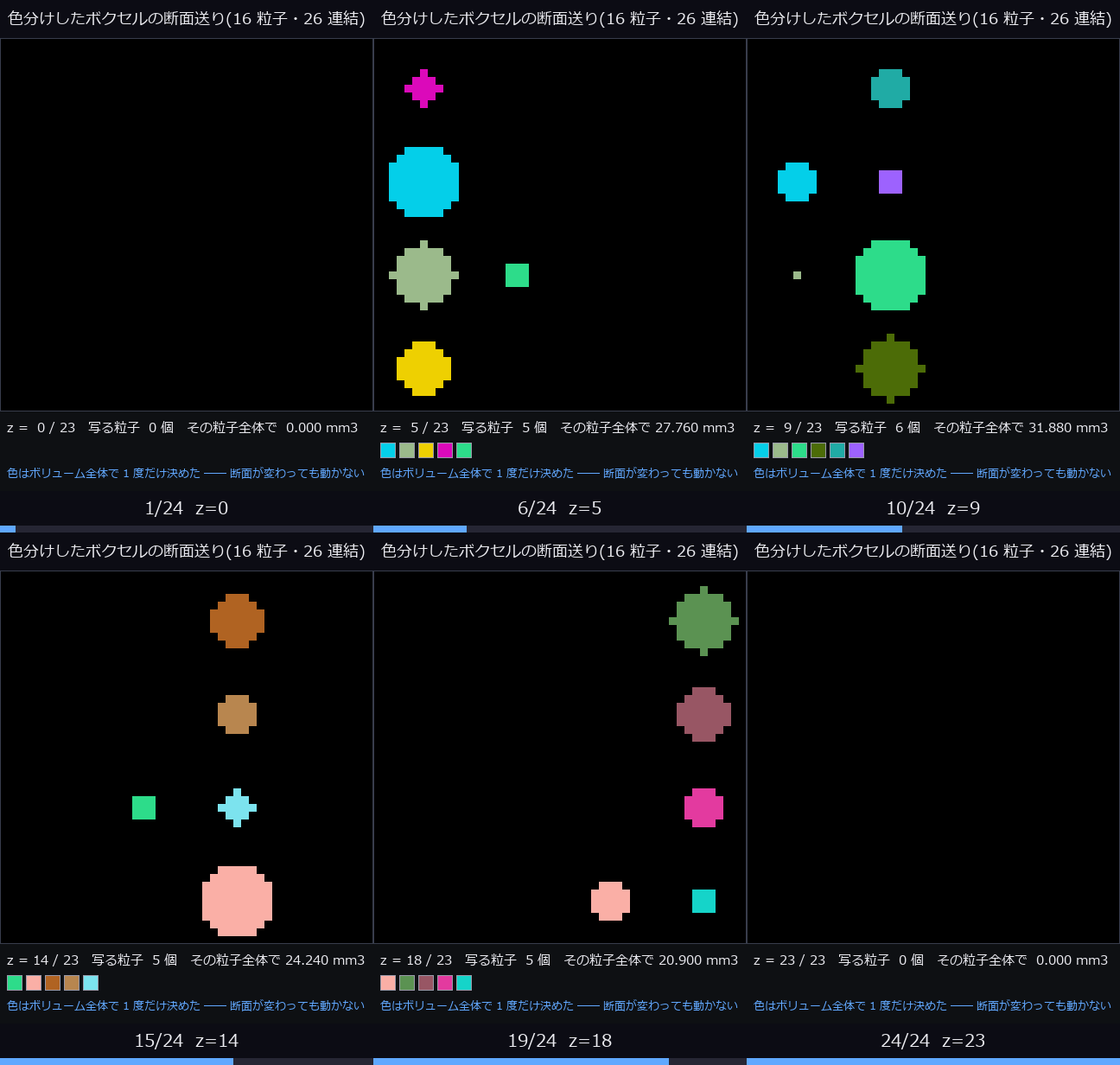
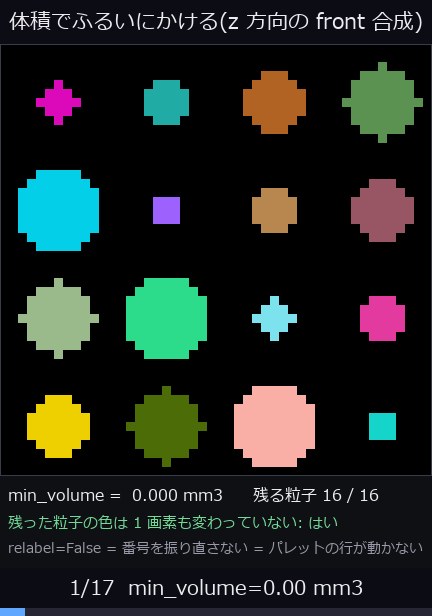
↑ Flipping through colour-coded voxel slices — 16 particles labelled with 26-connectivity, coloured as a volume and only then cut into 24 slices. Each particle keeps one colour from first slice to last (measured: all 16 components have exactly one colour). At a spacing of (0.50, 0.20, 0.20) mm they total 62.560 mm3. Ops used: vol_label, vol_colorize_labels, vol_label_slice_rgb, vol_label_shape_stats, vol_label_palette.
- GIF:
docs/articles/assets/media/wingvox_slice_flow.gif(24 frames, 432x616 px, 0.33 MB) - Thumbnail:
docs/articles/assets/thumbs/wingvox_slice_flow_thumb.jpg - Bundling: Flipbook GIF (a process advancing at one fixed size)
- SHA-256:
769ad42caa6786932daf625bafa14a34686fc299dc96b23a11404564b9343228
The measured values burned into this figure
```json { "components": 16, "slices": 24, "shape": [ 24, 48, 48 ], "spacing_mm": [ 0.5, 0.2, 0.2 ], "total_volume_mm3": 62.56, "colours_per_component": 1 } ```2. Flicker, side by side — the only difference is the order
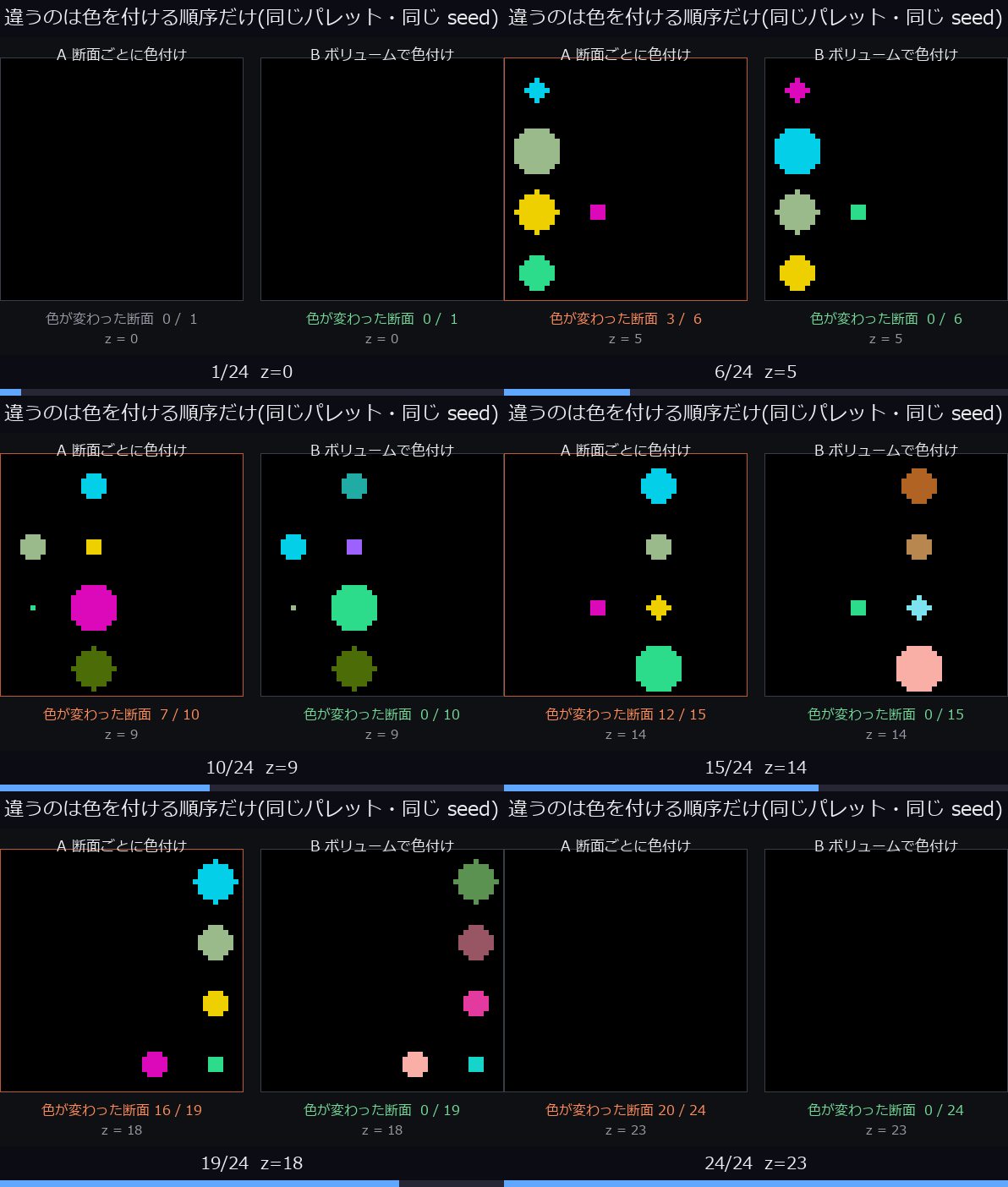
↑ Flicker, side by side — the only difference is the order — On the left each slice is labelled in 2-D and coloured on its own, so the numbering is redrawn every slice: on 20 of 24 slices at least one particle changes colour (62 of 108 (particle, slice) pairs = 57.4 %, and all 16 particles change at least once). On the right the volume is coloured first and cut afterwards: 0 slices, 0 pairs. Same palette, same seed — only the order differs. Ops used: vol_label, vol_label_color_flicker, vol_colorize_labels, vol_label_slice_rgb, colorize_labels.
- GIF:
docs/articles/assets/media/wingvox_flicker.gif(24 frames, 596x468 px, 0.37 MB) - Thumbnail:
docs/articles/assets/thumbs/wingvox_flicker_thumb.jpg - Bundling: Flipbook GIF (both halves composited into one frame so they advance together)
- SHA-256:
b22e88054154f9ce33e1504ed9e4b109955e2e7f86d24227cdff77f8fd732a41
The measured values burned into this figure
```json { "components": 16, "slices": 24, "per_slice_changed_slices": 20, "per_slice_changed_pairs": 62, "pairs_checked": 108, "per_slice_changed_components": 16, "flicker_rate_pct": 57.4, "volume_changed_slices": 0, "volume_changed_pairs": 0, "burned_in_running_total": 20 } ```3. 6 / 18 / 26 connectivity — the neighbourhood decides the count
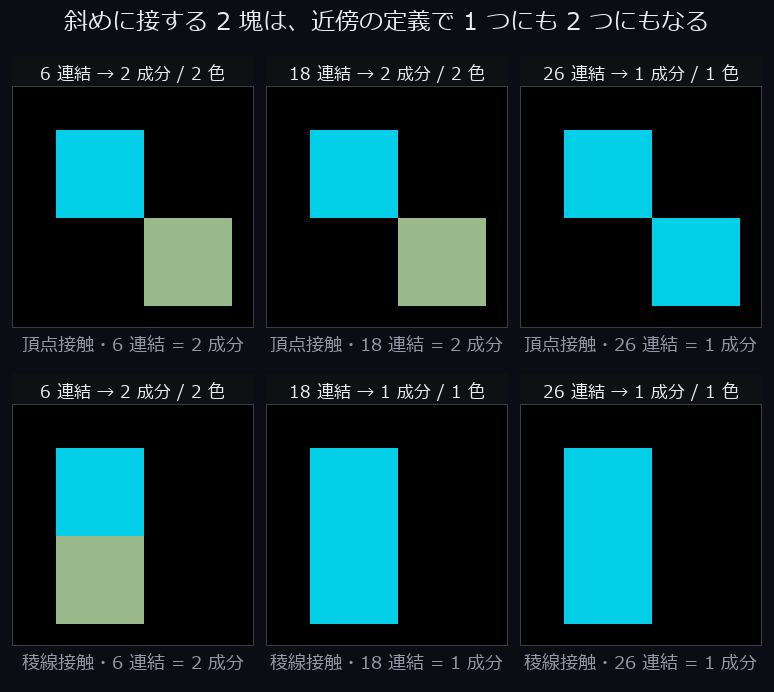
↑ 6 / 18 / 26 connectivity — the neighbourhood decides the count — The same two cubes: touching at a single corner they are 2 components under 6-connectivity, 2 under 18 and 1 under 26; touching along an edge, 2 / 1 / 1. The number of colours follows the number of components exactly — merge two blobs and one colour disappears. Ops used: vol_label, vol_label_volume_render, vol_label_palette.
- PNG (contact sheet):
docs/articles/assets/wingvox_connectivity.png(774x692 px, 31 kB, 6 panels / 3 columns) - Thumbnail (shown in the article):
docs/articles/assets/wingvox_connectivity_thumb.jpg(57 kB) - Bundling: Contact sheet (6 panels comparing neighbourhood definitions on the same body)
- SHA-256:
1e71d481fec54a3b648163520a0c954e2077d102f7859d1b9da06e36196a01d6
The measured values burned into this figure
```json { "corner": { "6": 2, "18": 2, "26": 1 }, "edge": { "6": 2, "18": 1, "26": 1 } } ```4. Sieving by volume without moving a single colour
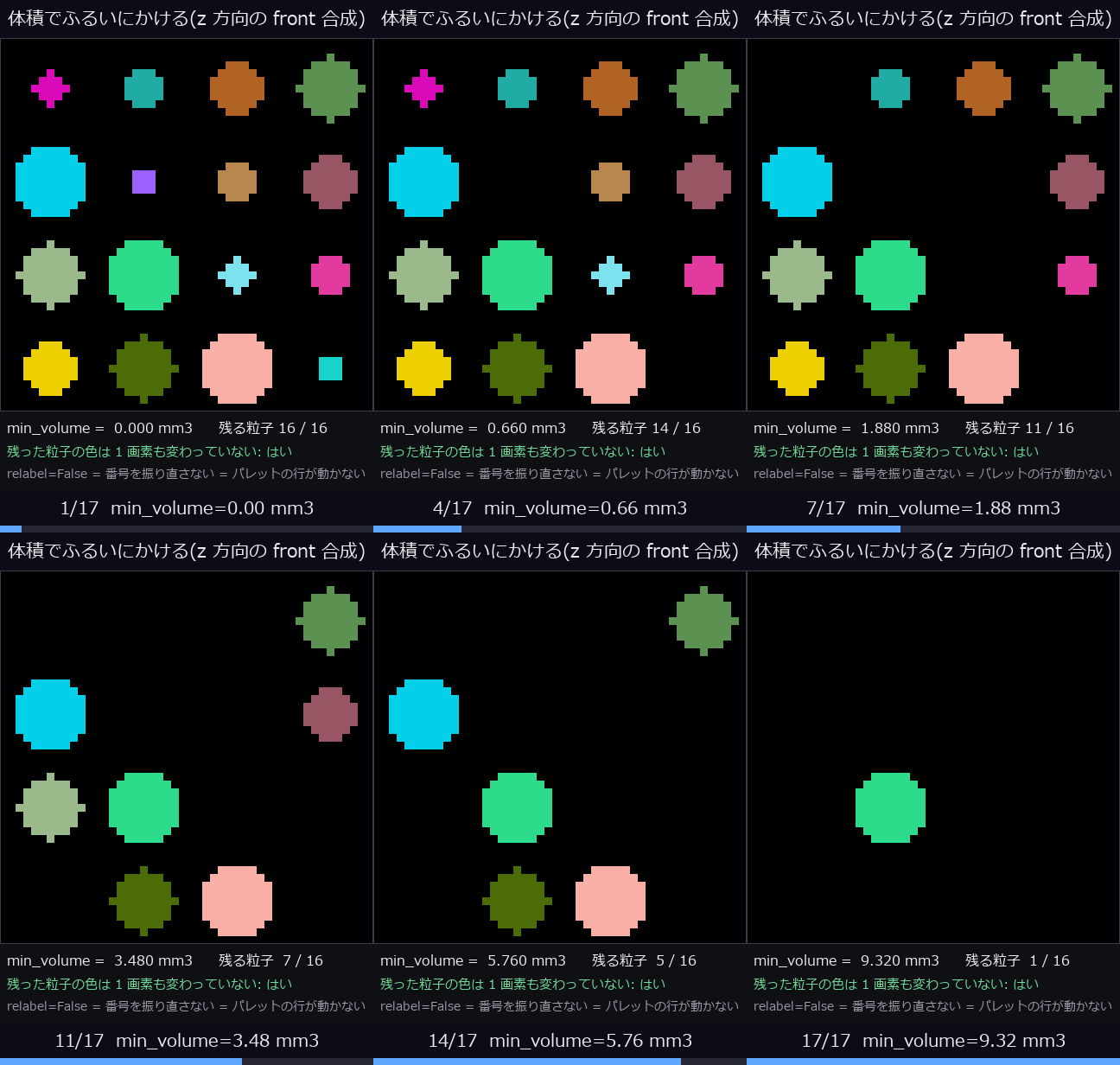
↑ Sieving by volume without moving a single colour — min_volume rises from 0 to 9.320 mm3 in 17 steps, dropping the particles one at a time. Those that fall out become background, but the survivors do not change colour by a single pixel (checked on all 17 frames). That holds because the labels are not renumbered (relabel=False); renumbering shifts the palette rows and repaints everything. Ops used: vol_label, vol_label_shape_stats, vol_select_labels, vol_label_volume_render, vol_colorize_labels.
- GIF:
docs/articles/assets/media/wingvox_sieve.gif(17 frames, 432x616 px, 0.30 MB) - Thumbnail:
docs/articles/assets/thumbs/wingvox_sieve_thumb.jpg - Bundling: Flipbook GIF (the threshold advances)
- SHA-256:
ed2622bdcb2dbbd98d792fb9c4e15c65ef20c0c688f4e3f272345affcfc97bd6
The measured values burned into this figure
```json { "components": 16, "steps": 17, "volumes_mm3": [ 0.56, 0.56, 0.66, 0.66, 1.62, 1.88, 1.88, 3.42, 3.42, 3.48, 5.14, 5.76, 5.76, 9.22, 9.22, 9.32 ], "all_colours_unchanged": true, "sweep": [ { "min_volume_mm3": 0.0, "kept": 16, "colours_unchanged": true }, { "min_volume_mm3": 0.56, "kept": 16, "colours_unchanged": true }, { "min_volume_mm3": 0.56, "kept": 16, "colours_unchanged": true }, { "min_volume_mm3": 0.66, "kept": 14, "colours_unchanged": true }, { "min_volume_mm3": 0.66, "kept": 14, "colours_unchanged": true }, { "min_volume_mm3": 1.62, "kept": 12, "colours_unchanged": true }, { "min_volume_mm3": 1.88, "kept": 11, "colours_unchanged": true }, { "min_volume_mm3": 1.88, "kept": 11, "colours_unchanged": true }, { "min_volume_mm3": 3.42, "kept": 9, "colours_unchanged": true }, { "min_volume_mm3": 3.42, "kept": 9, "colours_unchanged": true }, { "min_volume_mm3": 3.48, "kept": 7, "colours_unchanged": true }, { "min_volume_mm3": 5.14, "kept": 6, "colours_unchanged": true }, { "min_volume_mm3": 5.76, "kept": 5, "colours_unchanged": true }, { "min_volume_mm3": 5.76, "kept": 5, "colours_unchanged": true }, { "min_volume_mm3": 9.22, "kept": 3, "colours_unchanged": true }, { "min_volume_mm3": 9.22, "kept": 3, "colours_unchanged": true }, { "min_volume_mm3": 9.32, "kept": 1, "colours_unchanged": true } ] } ```5. Overlaying colour labels on the original CT — sweeping alpha
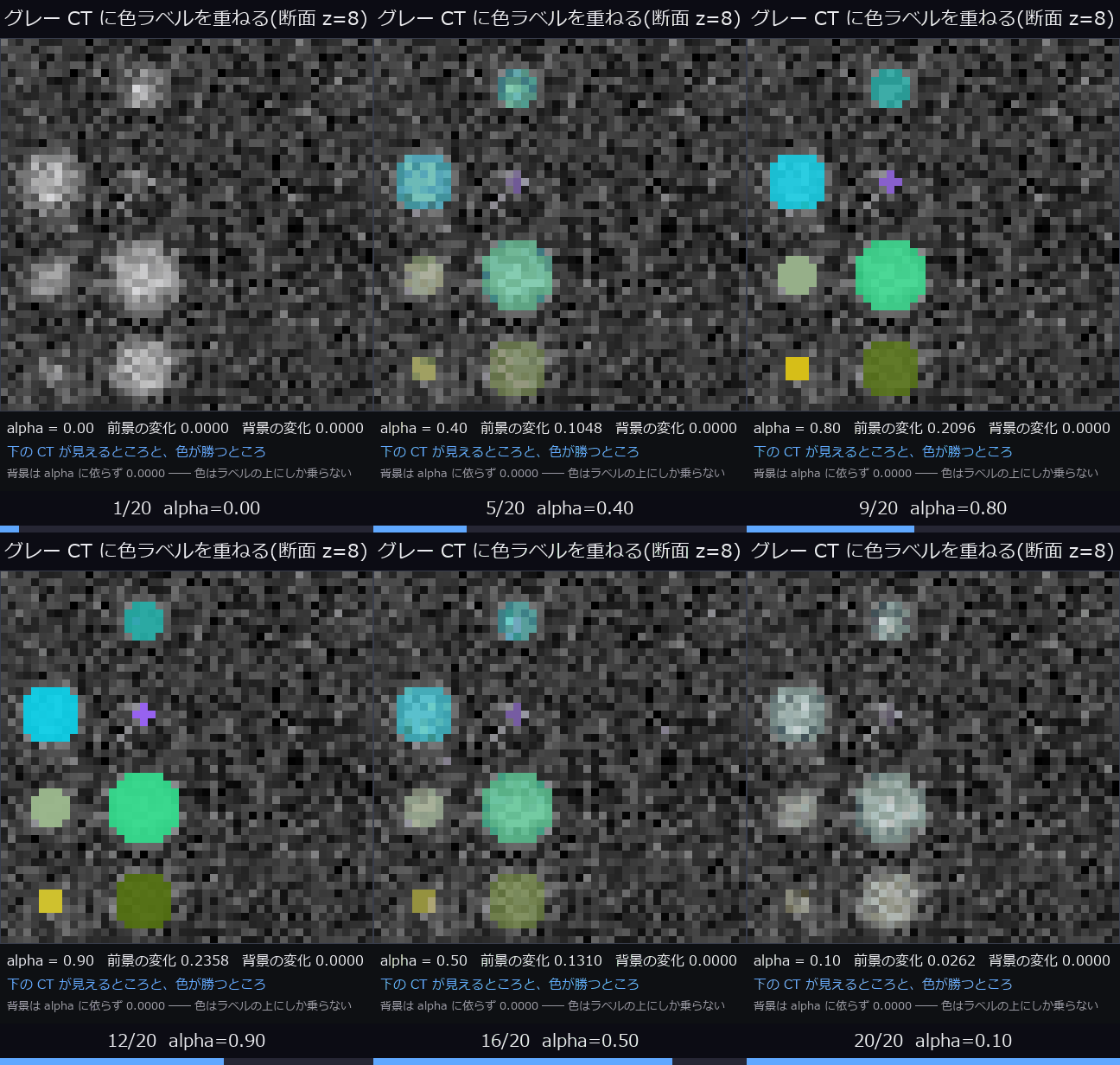
↑ Overlaying colour labels on the original CT — sweeping alpha — At slice z=8 alpha sweeps from 0 to 1 and back. The mean change over the foreground runs 0.0000 -> 0.0262, linear in alpha, while the background never moves at any alpha (0.0000) — colour only lands on labelled voxels. In mode='boundary' only 1648 of the 3128 foreground voxels (52.7 %) are painted, so the structure underneath stays visible. Ops used: vol_label, vol_label_overlay, vol_label_slice_rgb.
- GIF:
docs/articles/assets/media/wingvox_overlay_alpha.gif(20 frames, 432x616 px, 0.99 MB) - Thumbnail:
docs/articles/assets/thumbs/wingvox_overlay_alpha_thumb.jpg - Bundling: Flipbook GIF (alpha swept up and back)
- SHA-256:
fcb879348b2dcf66cdf37bc2aad03a7cc786499ee3c358d304a6d6f6636c1ca7
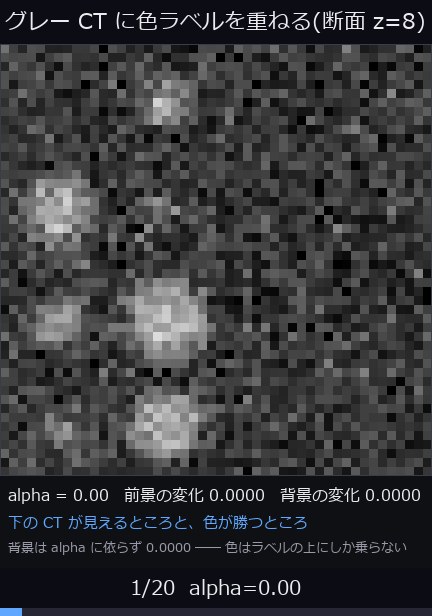
The measured values burned into this figure
```json { "slice": 8, "components": 16, "frames": 20, "sweep": [ { "alpha": 0.0, "fg_mean_abs_diff": 0.0, "bg_mean_abs_diff": 0.0 }, { "alpha": 0.1, "fg_mean_abs_diff": 0.0262, "bg_mean_abs_diff": 0.0 }, { "alpha": 0.2, "fg_mean_abs_diff": 0.0524, "bg_mean_abs_diff": 0.0 }, { "alpha": 0.3, "fg_mean_abs_diff": 0.0786, "bg_mean_abs_diff": 0.0 }, { "alpha": 0.4, "fg_mean_abs_diff": 0.1048, "bg_mean_abs_diff": 0.0 }, { "alpha": 0.5, "fg_mean_abs_diff": 0.131, "bg_mean_abs_diff": 0.0 }, { "alpha": 0.6, "fg_mean_abs_diff": 0.1572, "bg_mean_abs_diff": 0.0 }, { "alpha": 0.7, "fg_mean_abs_diff": 0.1834, "bg_mean_abs_diff": 0.0 }, { "alpha": 0.8, "fg_mean_abs_diff": 0.2096, "bg_mean_abs_diff": 0.0 }, { "alpha": 0.9, "fg_mean_abs_diff": 0.2358, "bg_mean_abs_diff": 0.0 }, { "alpha": 1.0, "fg_mean_abs_diff": 0.262, "bg_mean_abs_diff": 0.0 }, { "alpha": 0.9, "fg_mean_abs_diff": 0.2358, "bg_mean_abs_diff": 0.0 }, { "alpha": 0.8, "fg_mean_abs_diff": 0.2096, "bg_mean_abs_diff": 0.0 }, { "alpha": 0.7, "fg_mean_abs_diff": 0.1834, "bg_mean_abs_diff": 0.0 }, { "alpha": 0.6, "fg_mean_abs_diff": 0.1572, "bg_mean_abs_diff": 0.0 }, { "alpha": 0.5, "fg_mean_abs_diff": 0.131, "bg_mean_abs_diff": 0.0 }, { "alpha": 0.4, "fg_mean_abs_diff": 0.1048, "bg_mean_abs_diff": 0.0 }, { "alpha": 0.3, "fg_mean_abs_diff": 0.0786, "bg_mean_abs_diff": 0.0 }, { "alpha": 0.2, "fg_mean_abs_diff": 0.0524, "bg_mean_abs_diff": 0.0 }, { "alpha": 0.1, "fg_mean_abs_diff": 0.0262, "bg_mean_abs_diff": 0.0 } ], "bg_untouched_at_every_alpha": true, "boundary_voxels": 1648, "fill_voxels": 3128, "boundary_share_pct": 52.7 } ```6. A turntable of colour-coded meshes
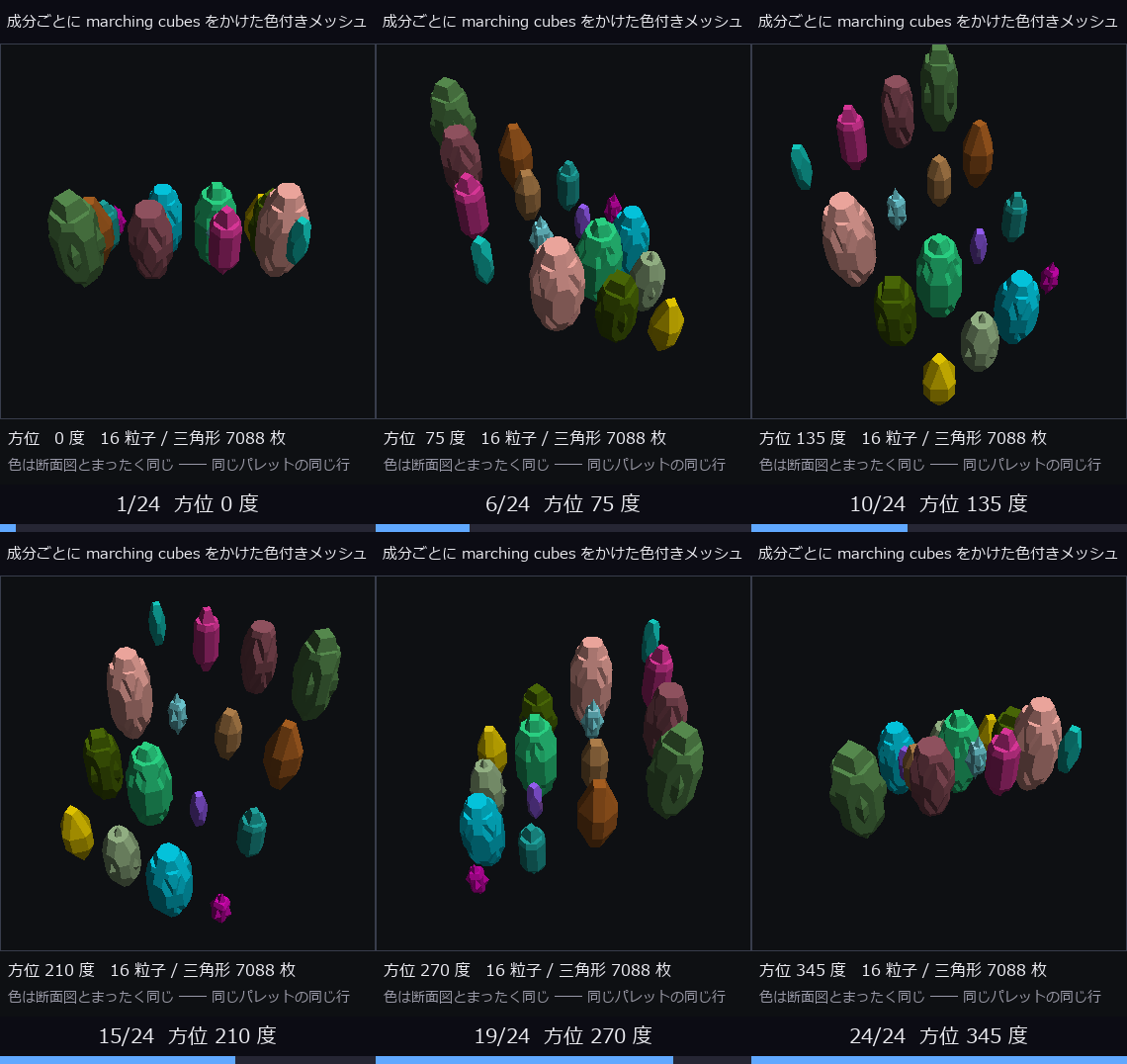
↑ A turntable of colour-coded meshes — Marching cubes runs on each component’s padded bounding box, giving 16 meshes and 7088 triangles for the 16 components. Vertices are in physical coordinates (spacing (0.50, 0.20, 0.20) mm) and the frames are composited through render3d.render_mesh’s z-buffer. The grains look stretched along z because they are — the slice pitch is 2.5x the in-plane pitch, the same point exhibit 4 makes. The colours are the same palette rows as the slice views, so the same particle can be followed between the cut and the rotation. Ops used: vol_label, vol_labels_to_meshes, look_at, intrinsics_from_fov, render_mesh.
- GIF:
docs/articles/assets/media/wingvox_mesh_turntable.gif(24 frames, 380x538 px, 0.45 MB) - Thumbnail:
docs/articles/assets/thumbs/wingvox_mesh_turntable_thumb.jpg - Bundling: Flipbook GIF (the azimuth advances)
- SHA-256:
4a2ba556d6751c838b4b68264026913f89e33a444e67eb73fc2606ec9d344240
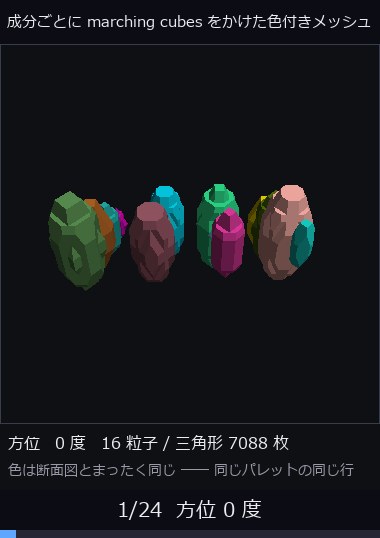
The measured values burned into this figure
```json { "components": 16, "meshes": 16, "triangles": 7088, "azimuth_steps": 24, "render_px": 380, "spacing_mm": [ 0.5, 0.2, 0.2 ], "colours_match_slices": true } ```7. A measurement table with its legend — which colour is which particle
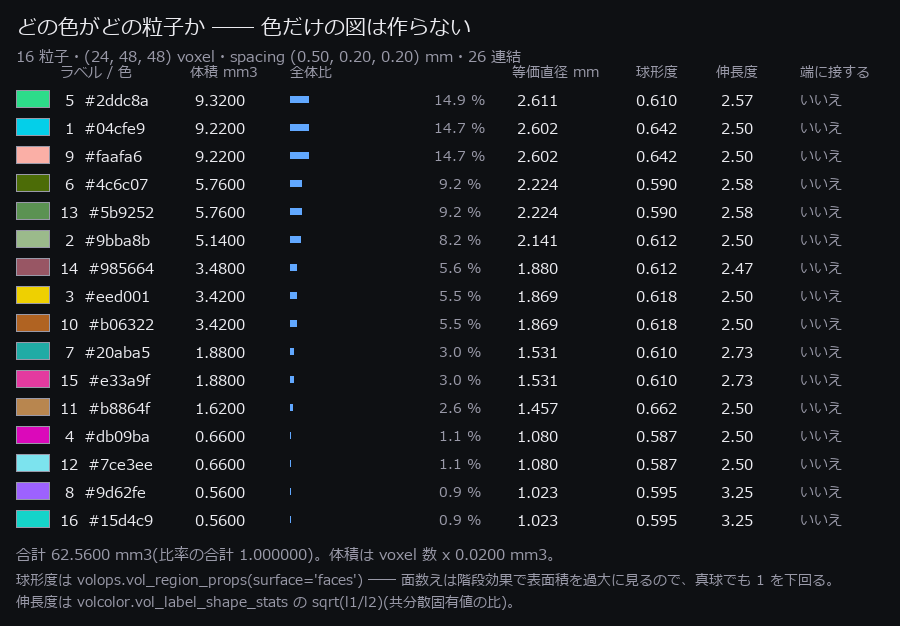
↑ A measurement table with its legend — which colour is which particle — A colour-coded figure without a legend is merely decorative. This table lists all 16 particles: swatch, volume in mm3, share of the total, equivalent diameter, sphericity, elongation and whether the particle touches the field of view. Total 62.5600 mm3, shares summing to 1.000000, one voxel = 0.020000 mm3. The largest is #2ddc8a at 9.3200 mm3, the smallest #15d4c9 at 0.5600 mm3. Ops used: vol_label, vol_region_props, vol_label_shape_stats, vol_label_legend, vol_label_palette.
- PNG (full size):
docs/articles/assets/wingvox_legend.png(900x626 px, 104 kB) - Thumbnail (shown in the article):
docs/articles/assets/wingvox_legend_thumb.jpg(79 kB) - Bundling: Full size (the numbers are the point — shrinking makes them unreadable)
- SHA-256:
996d79e05286f61b29e5add295e2a5519b6e7b87a2eede1d8e5fdec023a2e504