fullseye
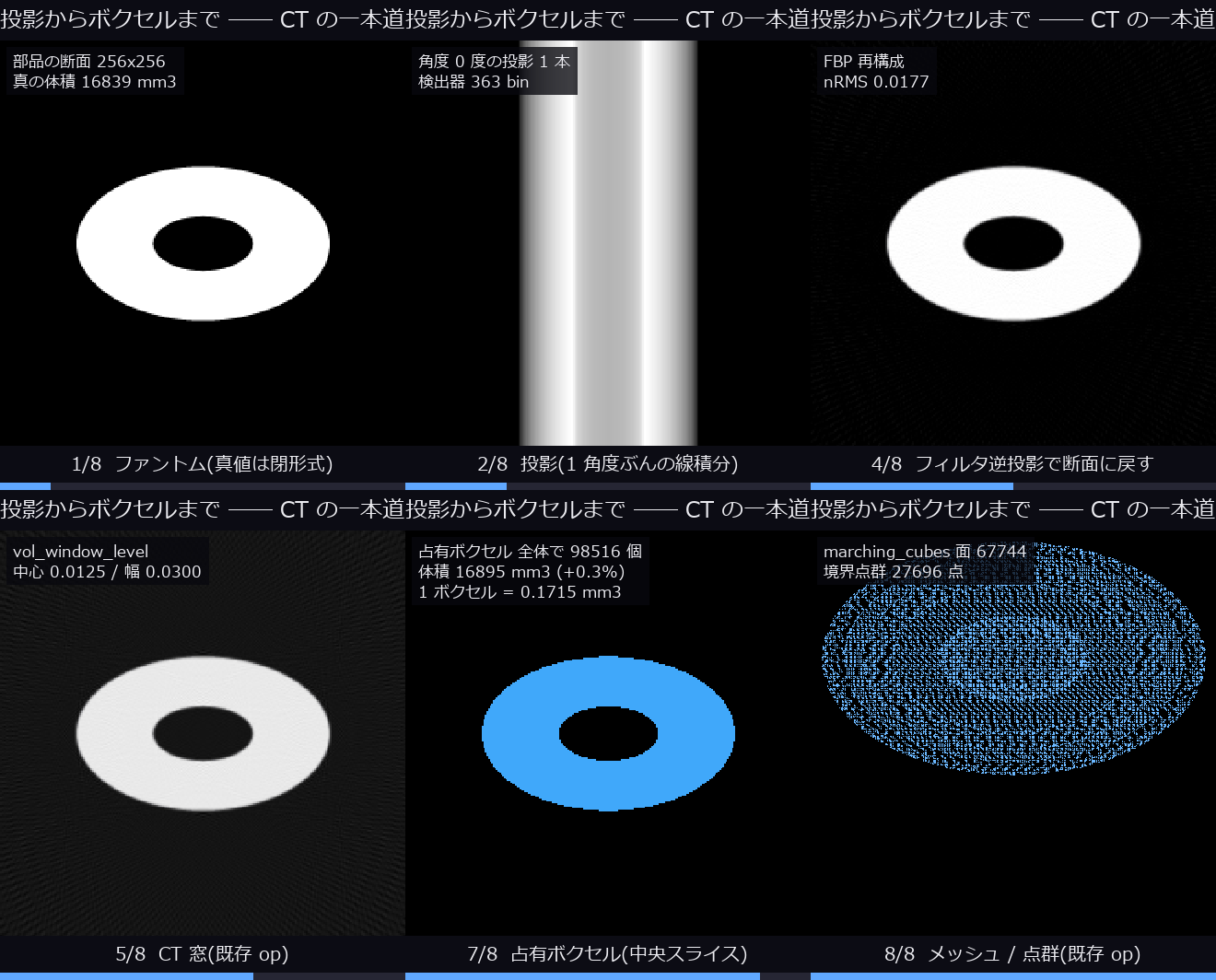
↑ From projections to voxels, the whole CT road — phantom, projection, sinogram, reconstruction, window, segmentation, voxels, mesh, in eight steps. A part whose volume is known in closed form (16839 mm³) rebuilt from 128 projections measures 16896 mm³ (+0.3%); reconstruction nRMS 0.0177, 67744 mesh faces, 27696 boundary points. Ops used: radon_volume, fbp_volume, vol_window_level, vol_label, vol_region_props, marching_cubes, vol_boundary_points.
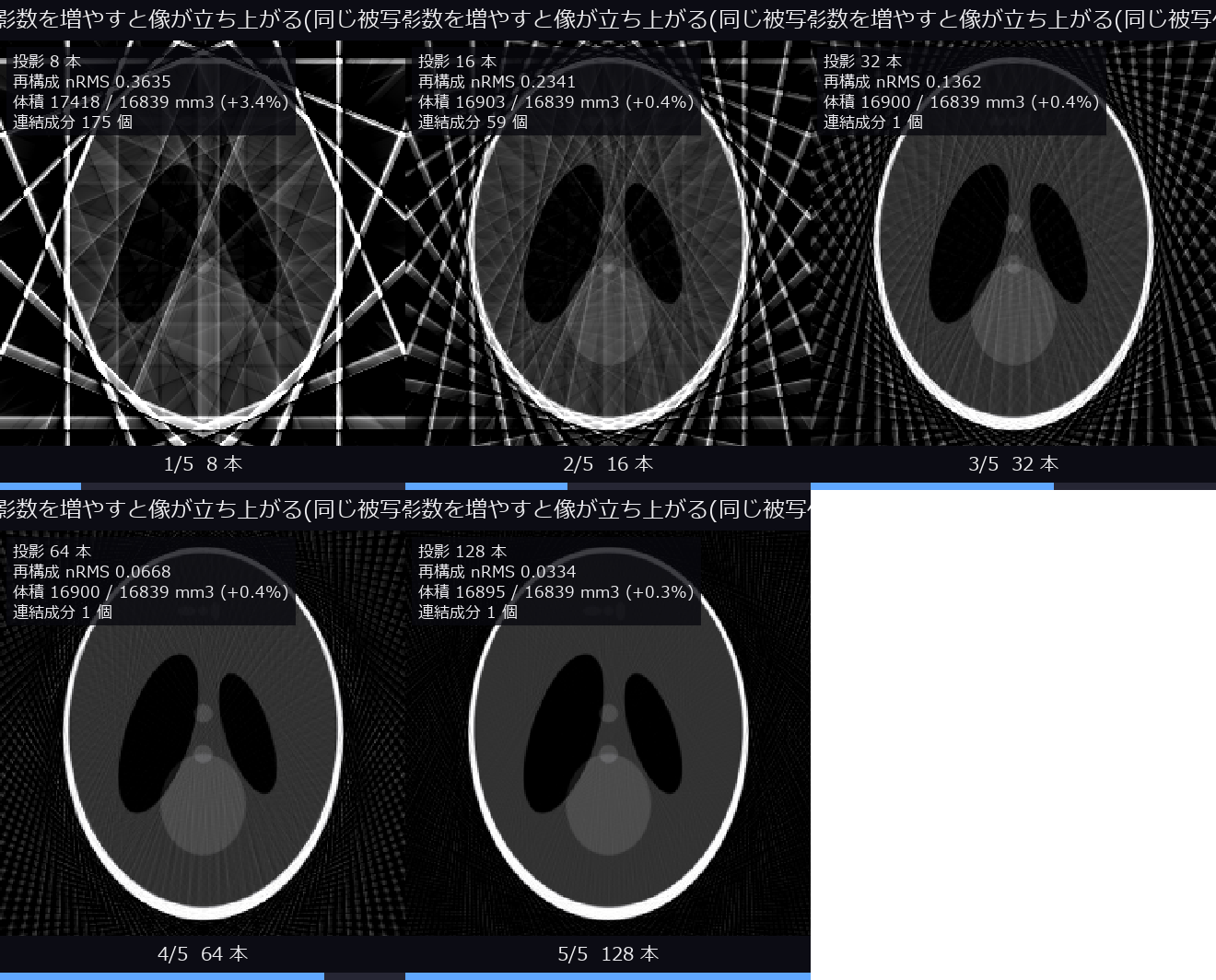
↑ More projections, and the image stands up — but the volume never says so — the same object at 8, 16, 32, 64 and 128 views. From 16 views on, reconstruction nRMS improves 0.2341 → 0.0334, a factor of 7.0, while the volume moves by only 0.04% (+0.38% → +0.34%): streaks appear symmetrically in sign around the object, so they cancel inside a single integrated quantity. The 8-view point is different — there the measure itself is untrustworthy (its +3.4% does not reproduce; the same part on a 128-pixel grid gives -0.0%). What does reveal the damage is the component count (175 against 1). Ops used: projection_angles, ellipse_sinogram, filtered_backprojection.
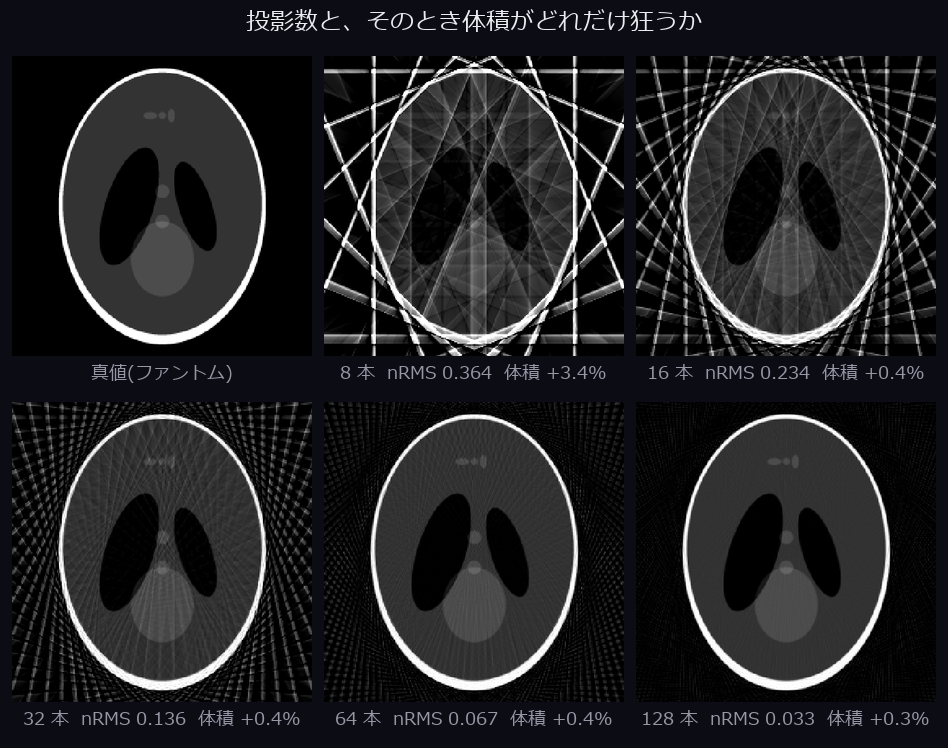
↑ The same thing as a tile — the truth top left, then 8 / 16 / 32 / 64 / 128 views. Labels carry the reconstruction nRMS and the volume error. At 8 views the inside of the skull is lost entirely in streaks and at 16 the fringes are still visible, yet the volume error is already +0.38% at 16 views and indistinguishable from the +0.34% at 128 — the visible improvement does not show up in the number. Ops used: ellipse_phantom, ellipse_sinogram, filtered_backprojection.
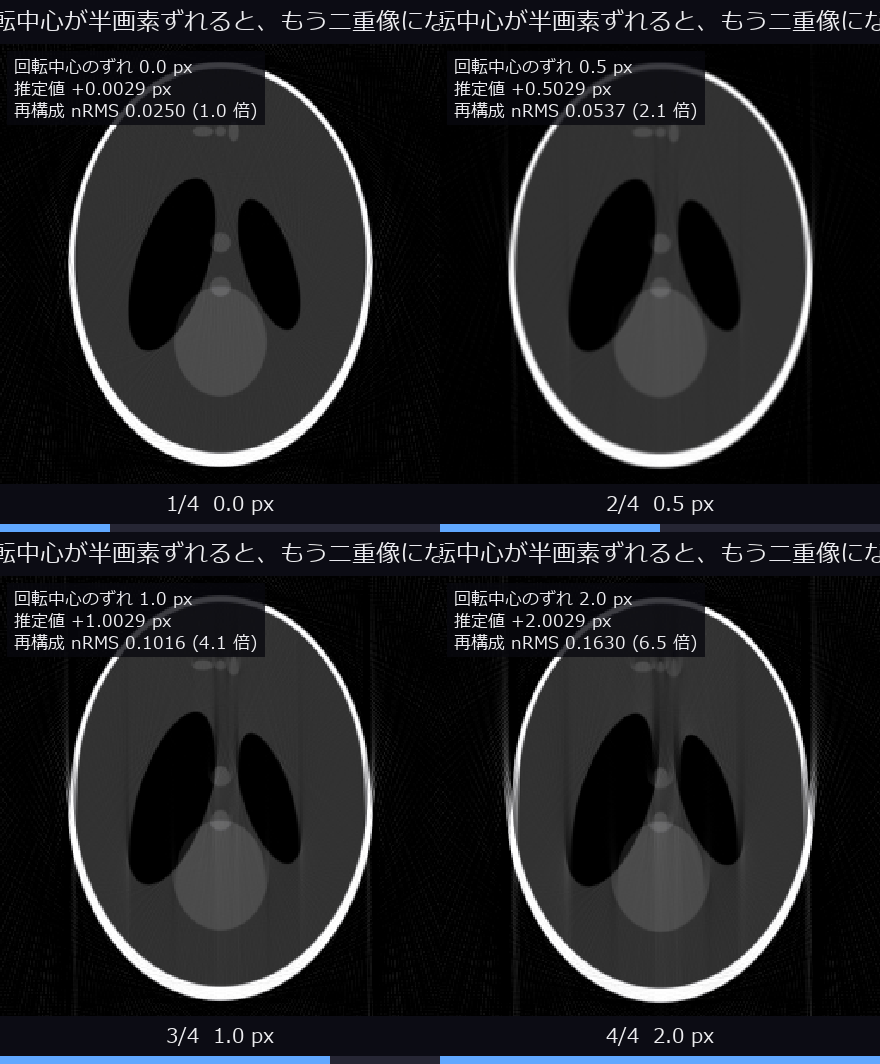
↑ Half a pixel of centre error is already a double image — 0, 0.5, 1 and 2 px. Reconstruction nRMS goes 0.0250 → 0.0537 → 0.1016 → 0.1630: half a pixel costs 2.1x the error while looking merely soft rather than wrong. sinogram_center_of_rotation recovers it from the centre-of-mass identity to within 0.0029 px. Ops used: sinogram_center_shift, sinogram_center_of_rotation.
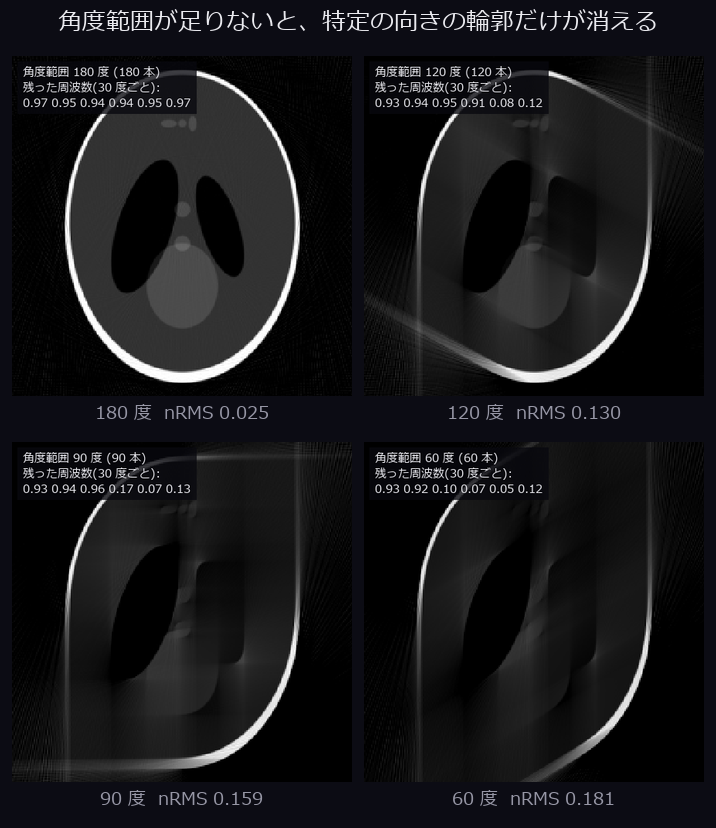
↑ A limited angular range deletes specific directions, not detail in general — 180, 120, 90 and 60 degrees. By the central-slice theorem the unmeasured wedge of the Fourier plane is simply empty. Measured as retained energy per 30-degree sector, a 90-degree scan holds 0.96 on the side it measured and falls to 0.07 on the side it did not. The surviving directions stay sharp, which is exactly what makes such a reconstruction convincing. Ops used: ellipse_sinogram, filtered_backprojection.
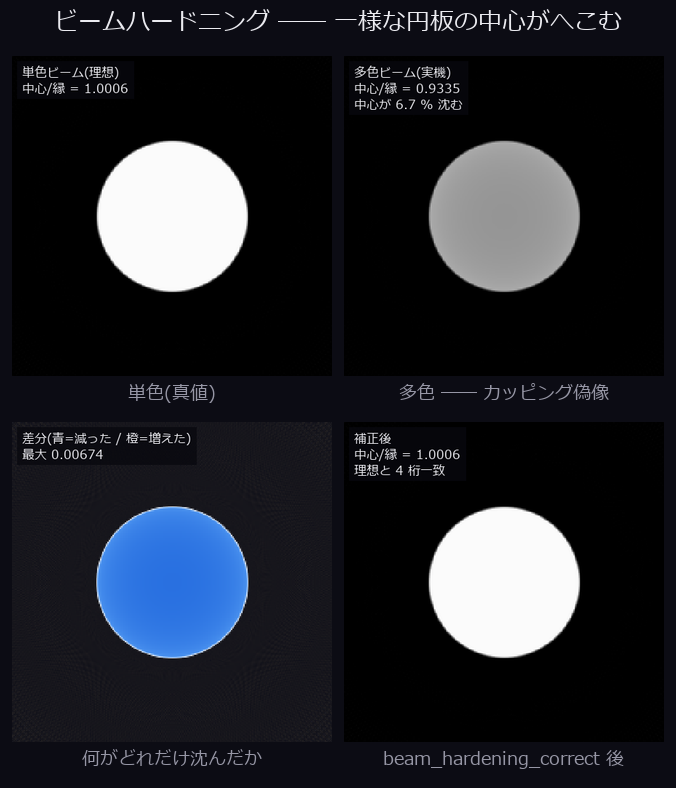
↑ Beam hardening — the centre of a uniform disc sinks — a real X-ray beam is not monochromatic, so a ray that survives a thicker path is harder and attenuates less per unit length, and the line integral stops being proportional to path length. The disc’s centre-to-rim ratio drops 1.0006 → 0.9335, and beam_hardening_correct returns it to 1.0006. The difference panel (blue = lost, orange = gained) shows that only the centre sank. Ops used: beam_hardening_apply, beam_hardening_correct.
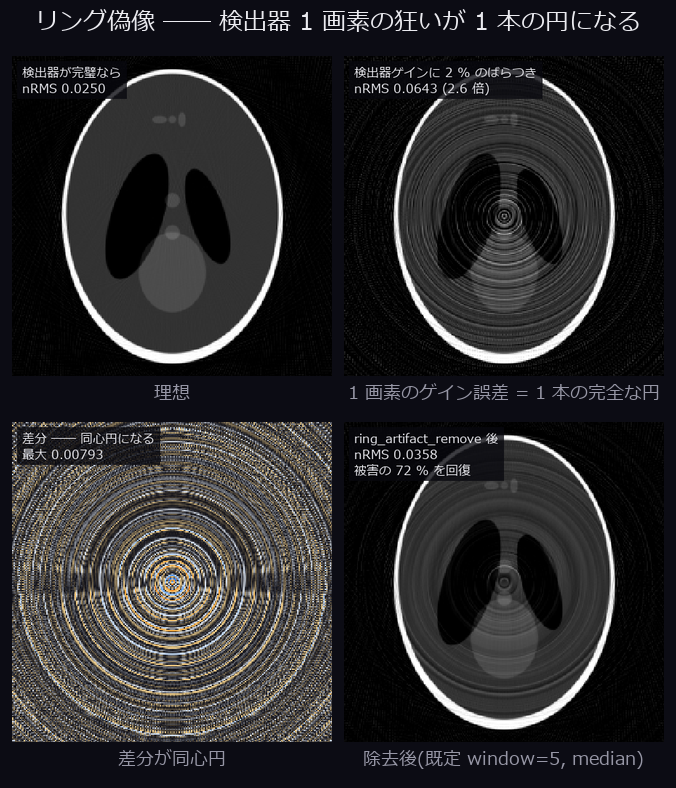
↑ Ring artefacts — one bad detector pixel becomes one perfect circle — a detector bin with gain g is offset, after the logarithm, by the same constant at every angle. Back-projecting a constant column smears it into a circle about the rotation axis. A 2 % gain spread takes nRMS 0.0250 → 0.0643 (2.6x), and ring_artifact_remove brings it to 0.0358, undoing 72% of the damage. Ops used: ring_artifact_apply, ring_artifact_remove.
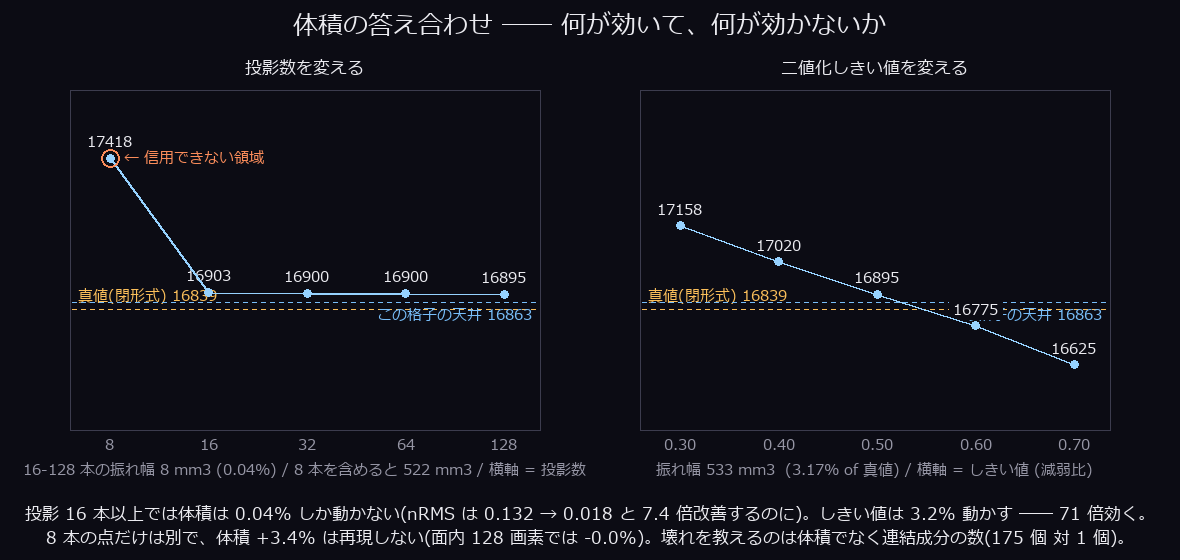
↑ Checking the volume — what matters, and what does not — the closed-form truth is 16839 mm³, and merely digitising it on this grid already gives 16863 mm³. On the left, sweeping the view count from 16 to 128 moves the answer by 8 mm³ (including the 8-view point makes it 522 mm³, but that point does not reproduce on a different grid); on the right, sweeping the binarisation threshold from 0.30 to 0.70 moves it by 533 mm³. The arbitrariness of the threshold matters 71x more than the view count, so the number to publish alongside a volume is which threshold cut it, not how many views took it. Ops used: radon_volume, fbp_volume, vol_label, vol_region_props.