fullseye
The Representation-Conversion Wing — exhibit captions
Generated by tools/gen_wingconv_gallery.py. Every picture is drawn with fullseye’s own ops
(reprconv / imagedraw) and numpy compositing — no matplotlib — and every number burnt
into a figure was measured by calling the op at generation time. Seeds and geometry are fixed,
so regeneration is byte-identical (--verify).
This wing makes one claim: a conversion’s lie shows up in the round trip. A conversion op
asserts both an input type and an output type, so it has two faces on which to lie. Hence the
lead exhibits are A → B → A' flipbooks whose last frame carries the residual and its number:
reversible → the residual is black, lossy → the loss is quantified.
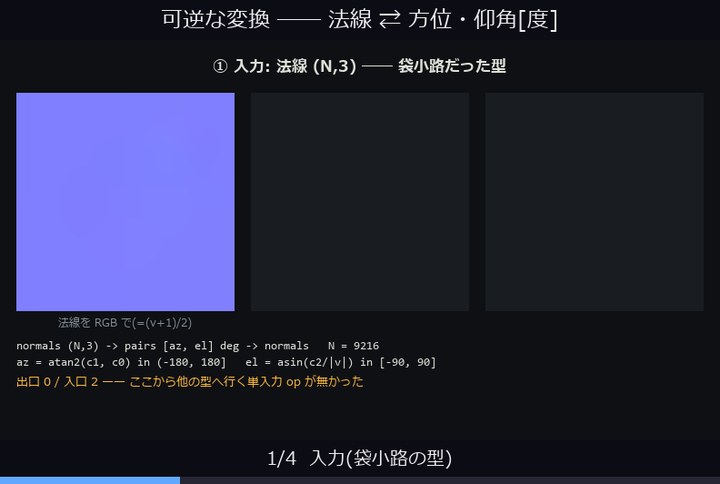
1. Reversible — normals ⇄ (azimuth, elevation) in degrees
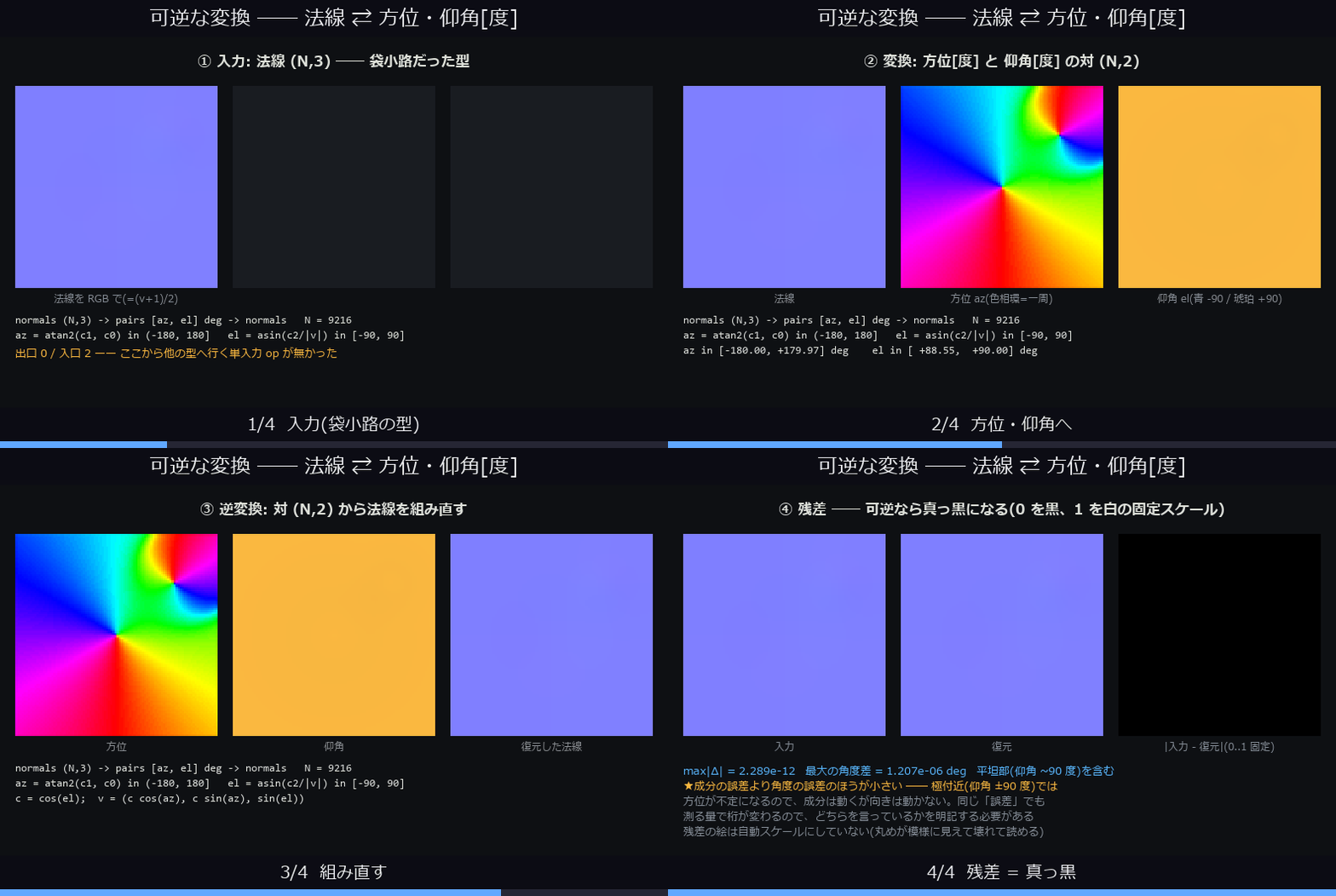
*↑ Reversible — normals ⇄ (azimuth, elevation) in degrees — The dead-end type normals now has an exit. Converting to azimuth and elevation (both in degrees) and back returns 9216 normals to **max |
Δ | = 2.289e-12** (1.207e-06 deg of angular error). The residual panel is black because it is drawn on a fixed 0..1 scale; auto-scaling would turn double-precision rounding into a visible pattern and make a reversible conversion look broken.* |
- GIF:
docs/articles/assets/media/wingconv_roundtrip_normals.gif(4 frame(s), 792x532 px, 0.14 MB) - Thumbnail:
docs/articles/assets/thumbs/wingconv_roundtrip_normals_thumb.jpg - SHA-256:
596e13795efe1cb08b5cd3ece7a414e76b261dc2d94ad62cf28f79ffac4580f4
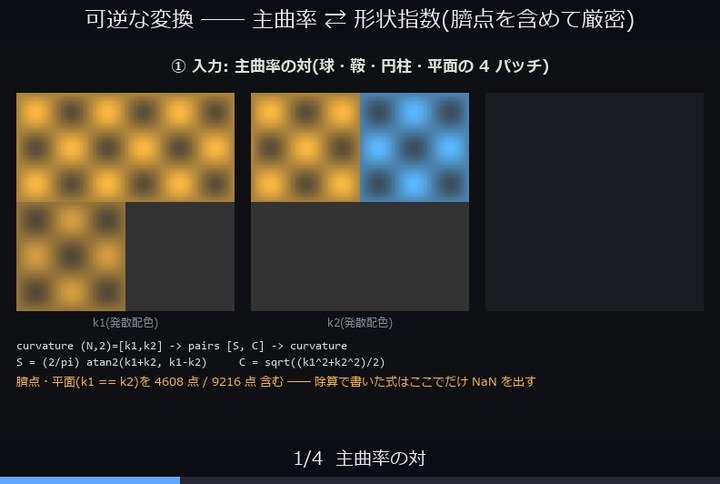
2. Reversible — principal curvatures ⇄ shape index (exact at umbilics)
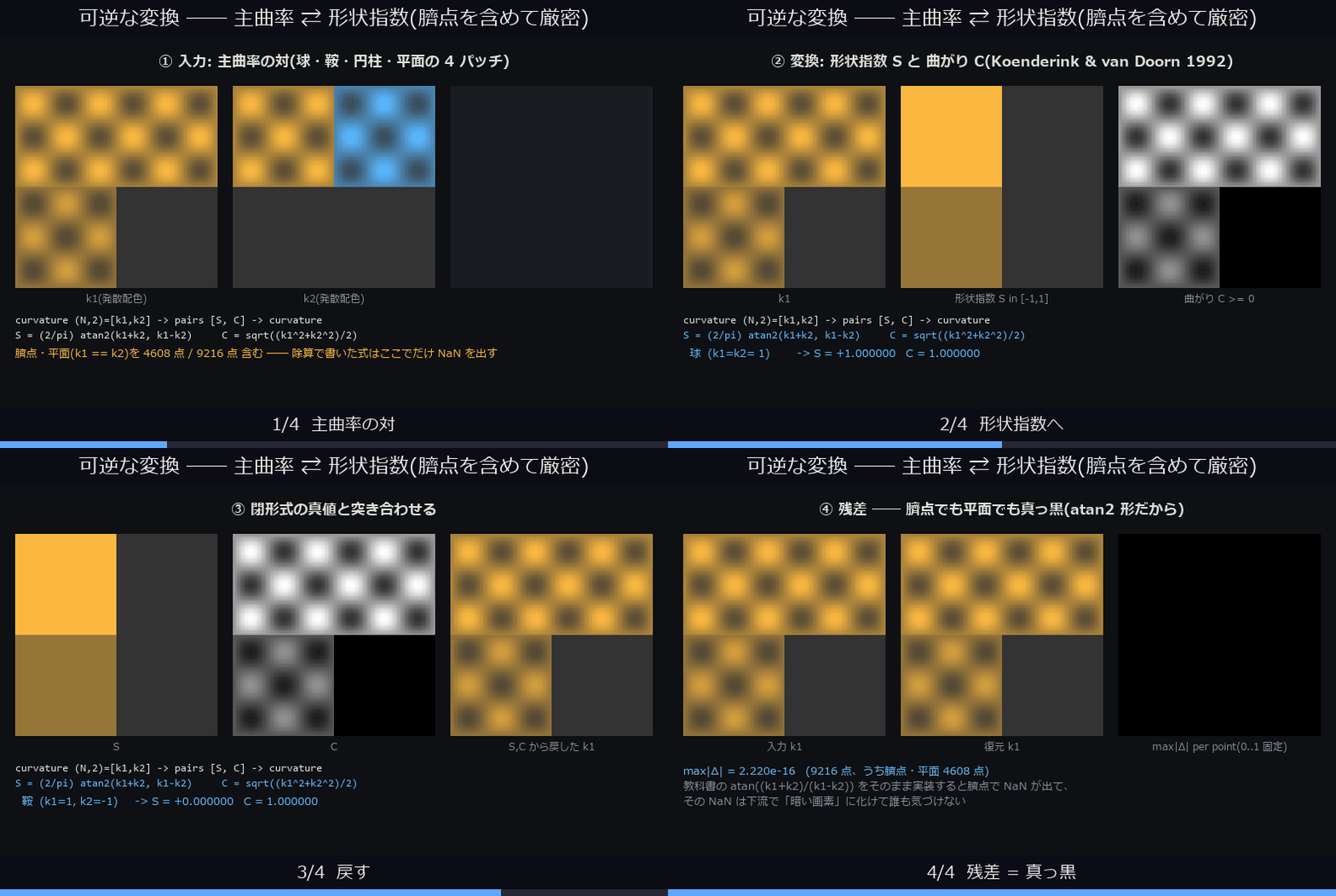
| *↑ Reversible — principal curvatures ⇄ shape index (exact at umbilics) — Four patches (sphere, saddle, cylinder, plane; 9216 points of which 4608 are umbilic or flat) map to shape index S and curvedness C and back to **max | Δ | = 2.220e-16*. The textbook form atan((k1+k2)/(k1-k2)) divides by zero at umbilics; the atan2 form keeps sphere S=+1, saddle S=0 and cylinder S=+0.5 exact everywhere. |
- GIF:
docs/articles/assets/media/wingconv_roundtrip_curvature.gif(4 frame(s), 792x532 px, 0.26 MB) - Thumbnail:
docs/articles/assets/thumbs/wingconv_roundtrip_curvature_thumb.jpg - SHA-256:
49783cc6f12b4829dcf731f0e771082a3629a2b7564c9fa1c97afbdb55d0d7c7
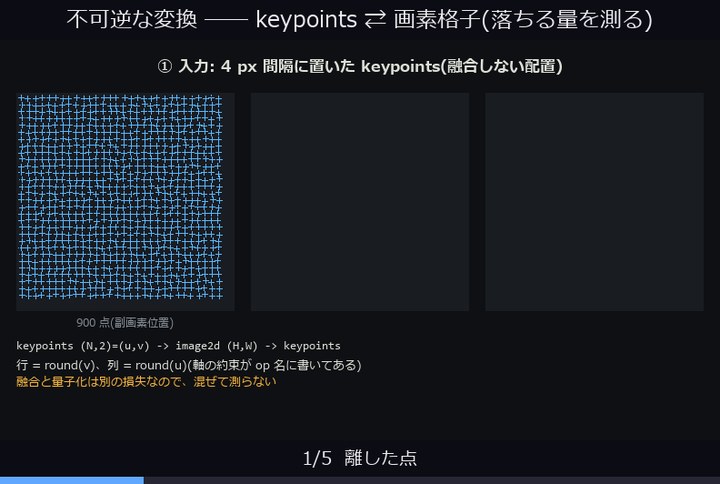
3. Lossy — keypoints ⇄ pixel raster (measure what is lost)
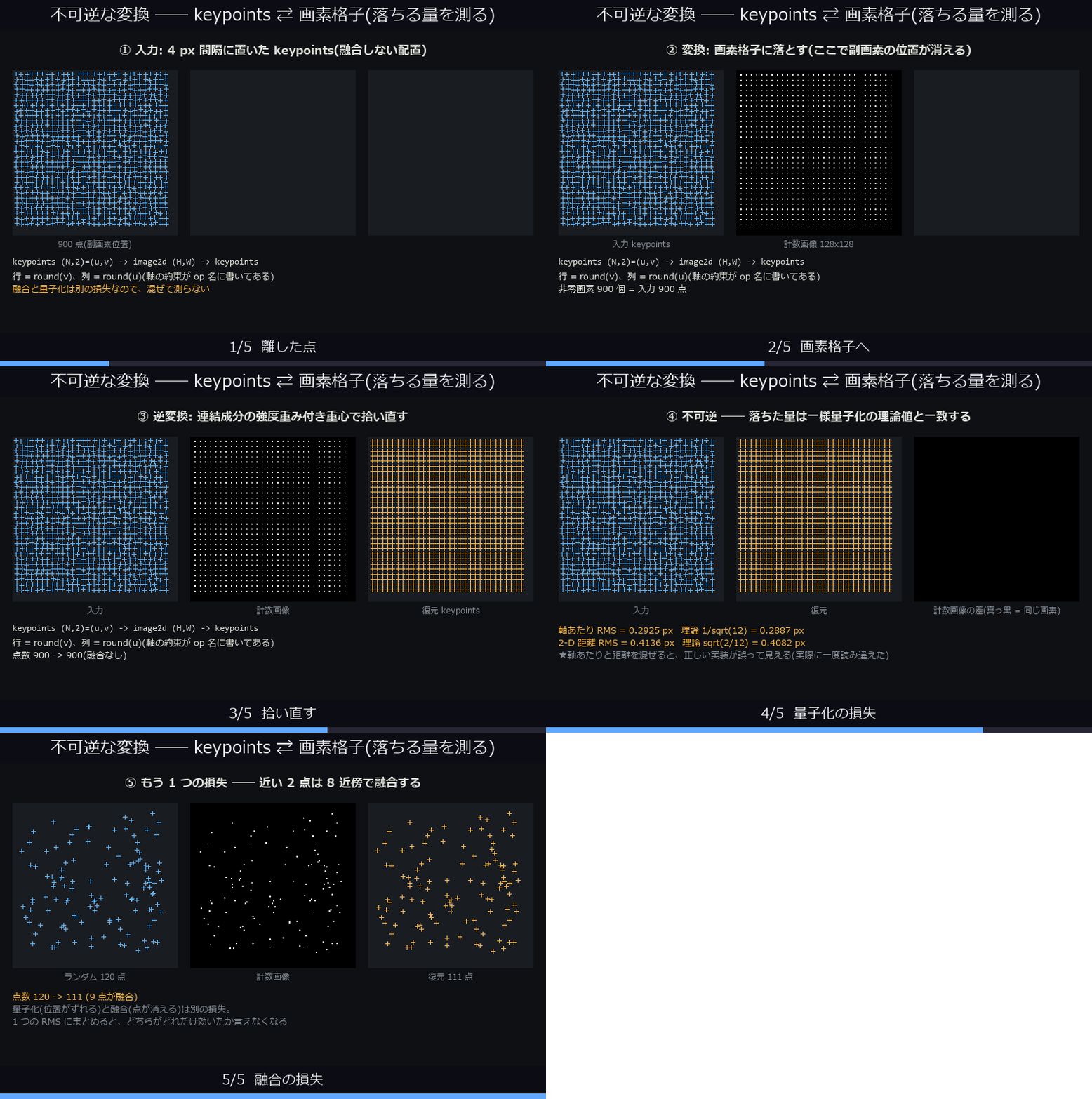
↑ Lossy — keypoints ⇄ pixel raster (measure what is lost) — 900 keypoints on a 4 px lattice, rasterised and picked back up, land 0.2925 px RMS per axis (uniform-quantisation theory 1/√12 = 0.2887) and 0.4136 px in 2-D distance (theory √(2/12) = 0.4082). Random placement merges 120 → 111 points — quantisation (displacement) and merging (disappearance) are different losses and collapsing them into one RMS hides which one dominates.
- GIF:
docs/articles/assets/media/wingconv_roundtrip_keypoints.gif(5 frame(s), 792x532 px, 0.14 MB) - Thumbnail:
docs/articles/assets/thumbs/wingconv_roundtrip_keypoints_thumb.jpg - SHA-256:
945237fc3c62ab0cf43d0830dc6992ac56ed353dd6fa0ca6b5b12a17bbc589ff
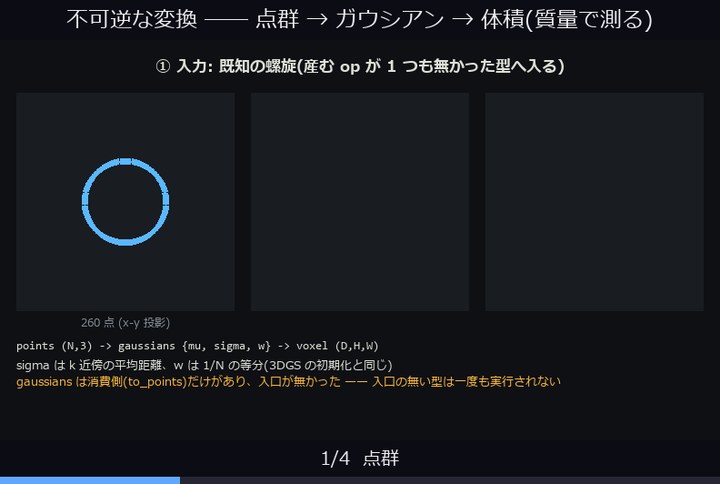
4. Lossy — points → gaussians → volume (measured by mass)
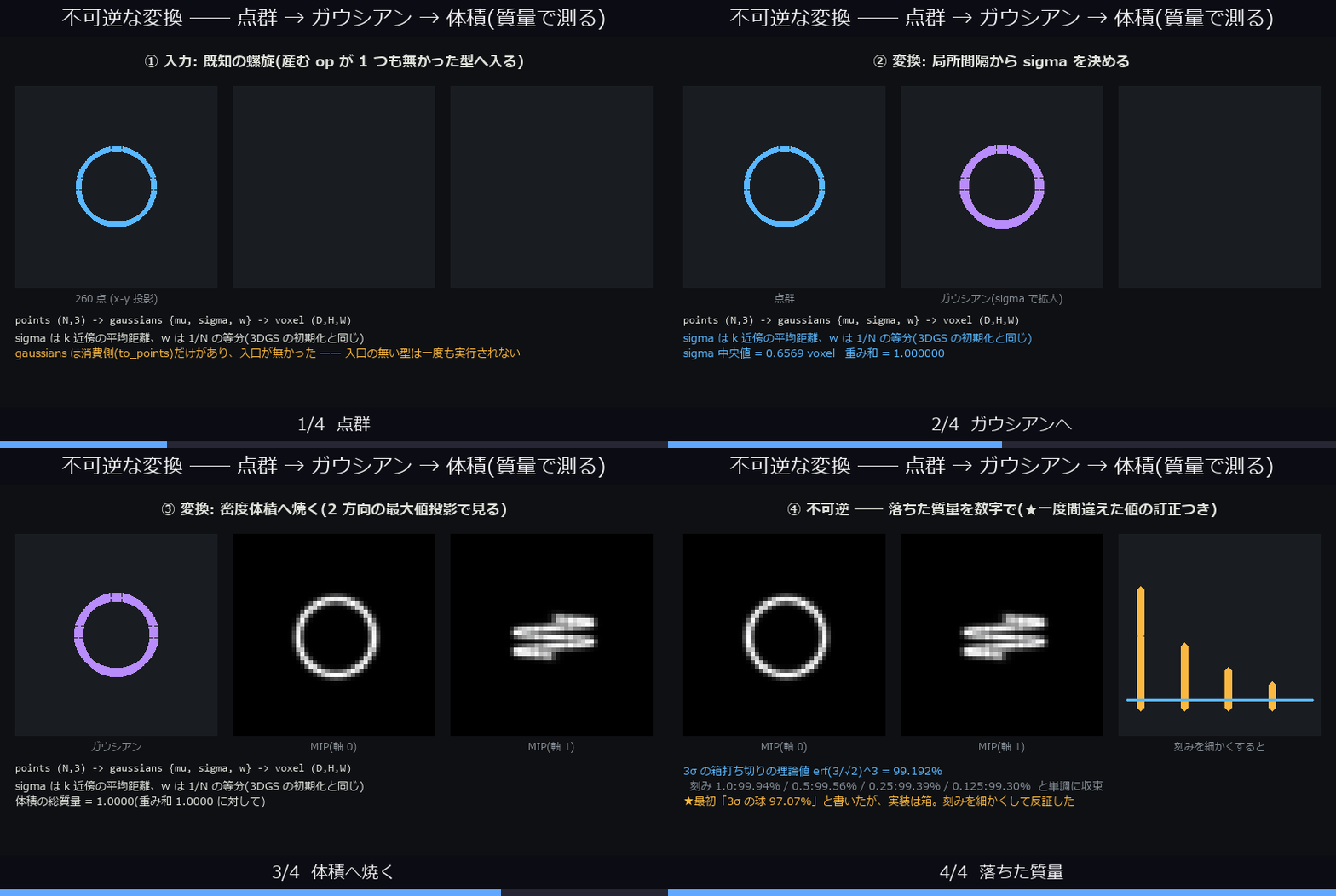
*↑ Lossy — points → gaussians → volume (measured by mass) — gaussians had no producing op at all; this adds the entrance. Centres round-trip bit-identically (max |
Δ | = 0.000e+00); sigma and w are information added, not lost. Splatting to a volume keeps 99.192% of the mass under a 3σ box truncation — first written as the 3σ ball value 97.07%, then refuted by refining the grid from 1.0 to 0.125, which converges to the box.* |
- GIF:
docs/articles/assets/media/wingconv_roundtrip_gaussians.gif(4 frame(s), 792x532 px, 0.10 MB) - Thumbnail:
docs/articles/assets/thumbs/wingconv_roundtrip_gaussians_thumb.jpg - SHA-256:
9e19ef2fa00ecb2688237735f958c2ba8e22c477ebb4334c81e81fc97d79319d
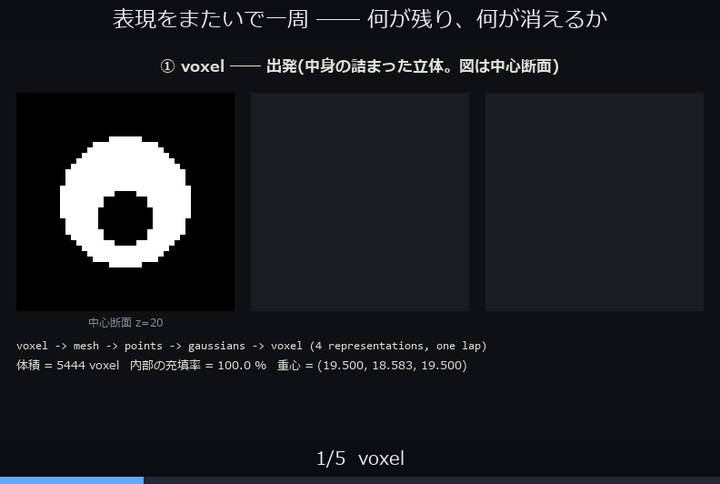
5. Around the representations — what survives and what does not
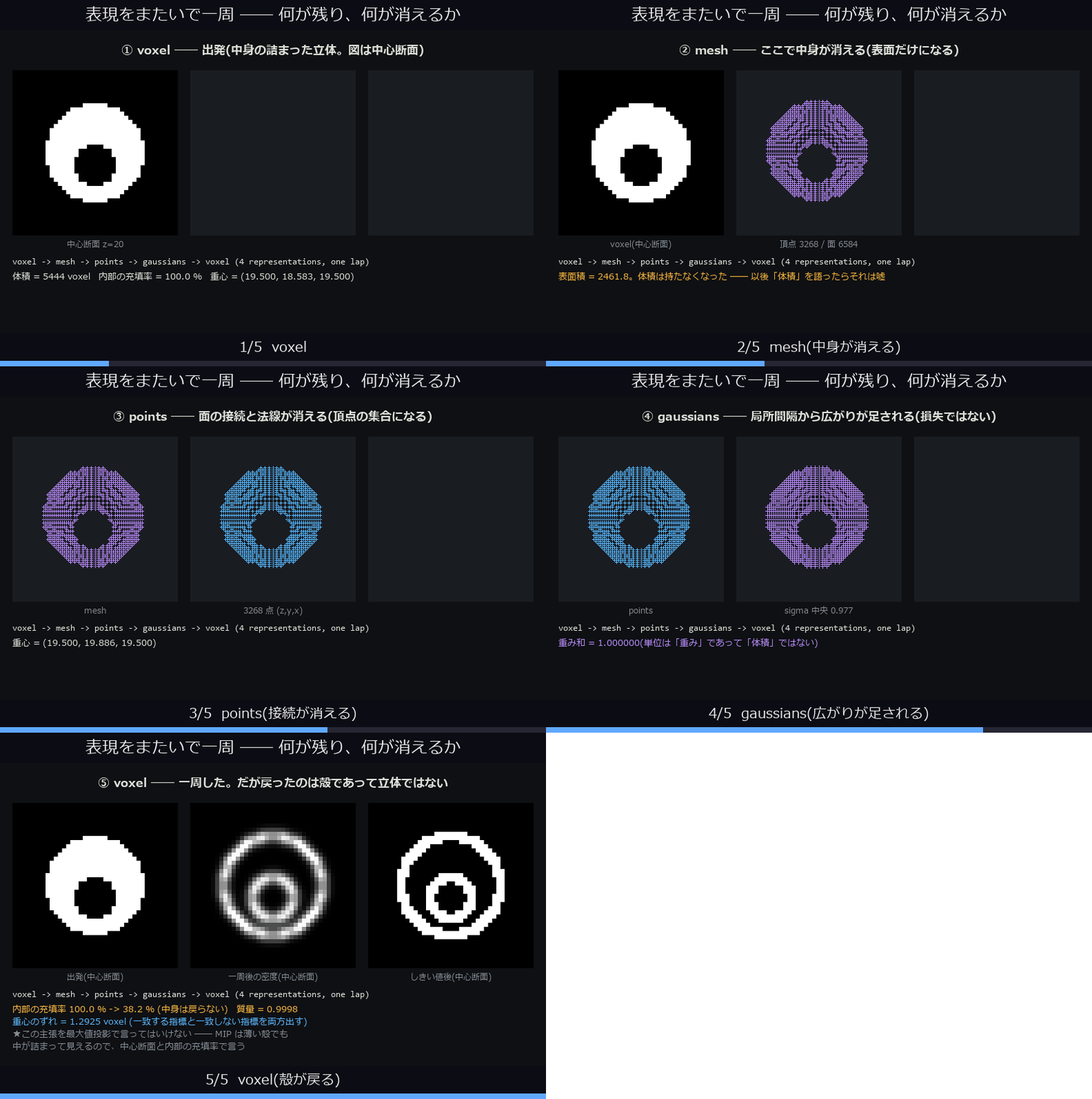
↑ Around the representations — what survives and what does not — voxel → mesh → points → gaussians → voxel. A solid of 5444 voxels loses its interior at the mesh stage (3268 vertices / 6584 faces, area 2461.8), loses connectivity and orientation at the points stage, and comes back as a shell: interior fill goes 100.0% → 38.2%. Yet the centroid moves only 1.2925 voxel. Reporting both an agreeing and a disagreeing metric is what keeps ‘it came back’ from being a lie. This claim cannot be made from a maximum-intensity projection — a thin shell still looks solid in MIP — so it is shown on a central slice.
- GIF:
docs/articles/assets/media/wingconv_cross_loop.gif(5 frame(s), 792x532 px, 0.12 MB) - Thumbnail:
docs/articles/assets/thumbs/wingconv_cross_loop_thumb.jpg - SHA-256:
fdefdaff55bb3f304a665ed94a74476b979ec3d54d64af23cdf7623273fd7d8a
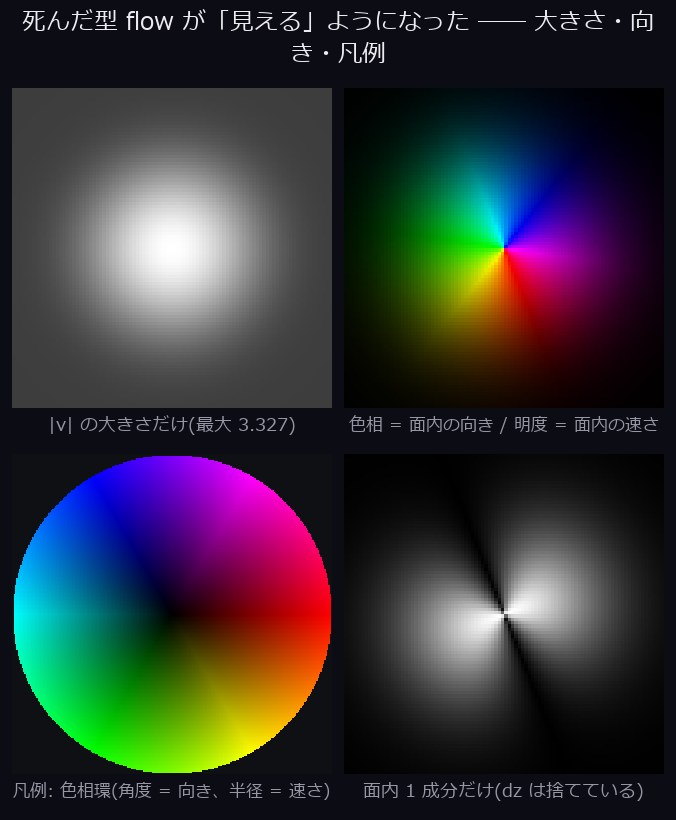
6. The dead type flow becomes visible
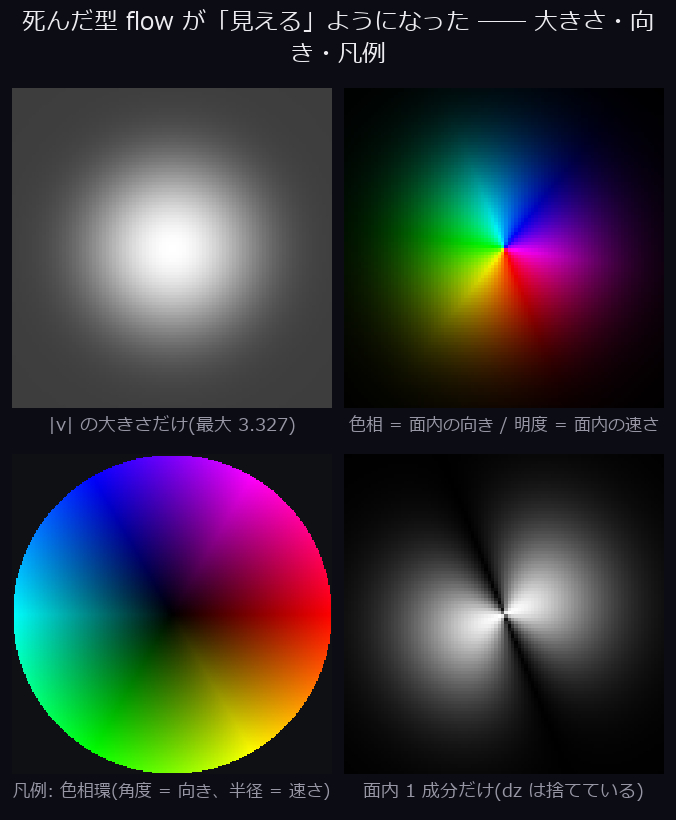
↑ The dead type flow becomes visible — flow was a complete island: no single-input op produced or consumed it. Dense scene flow [3, 24, 96, 96] now exits as magnitude (voxel) and as a colour wheel (rgbimage), with the colour legend burnt into the same figure. In this repo flow holds two different things under one name — dense (3,D,H,W) and scattered (N,3) — so the dense ops [‘flow_magnitude’, ‘flow_to_rgbimage’] and scattered ops [‘flow_speed’, ‘flow_apply’] are separate and fail closed on the other shape.
- PNG:
docs/articles/assets/wingconv_flow_colorwheel.png(1 frame(s), 676x820 px, 0.08 MB) - Thumbnail:
docs/articles/assets/wingconv_flow_colorwheel_thumb.jpg - SHA-256:
91311ab72227bd1007a04eb9053b33823dacd2d3bbe5eb3913935c1465729b98
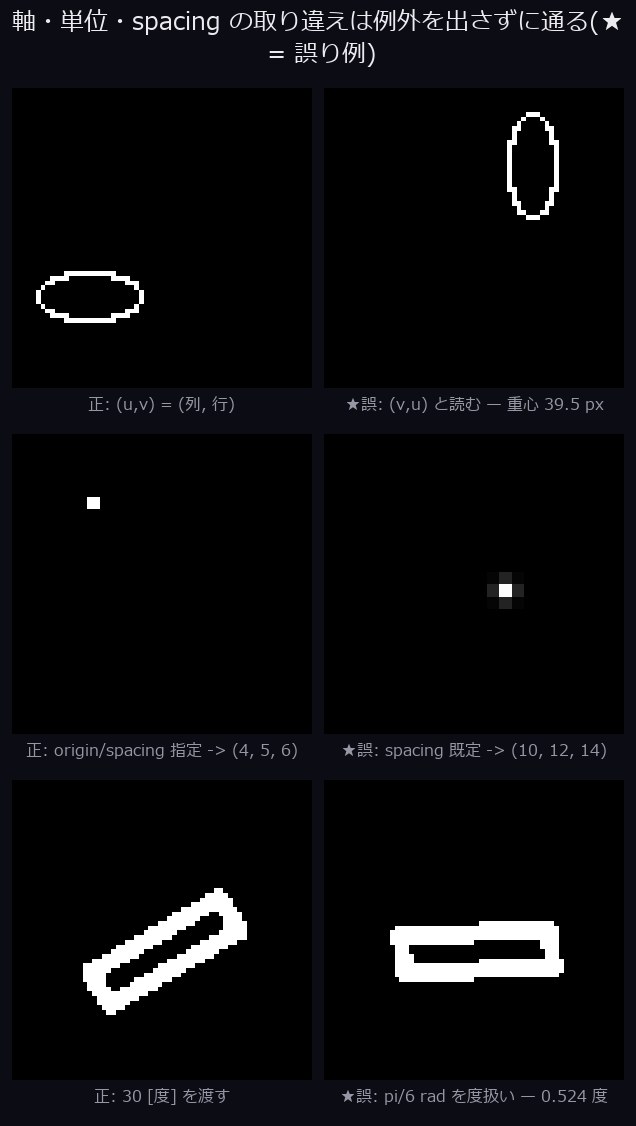
7. Axis, unit and spacing mix-ups pass without raising
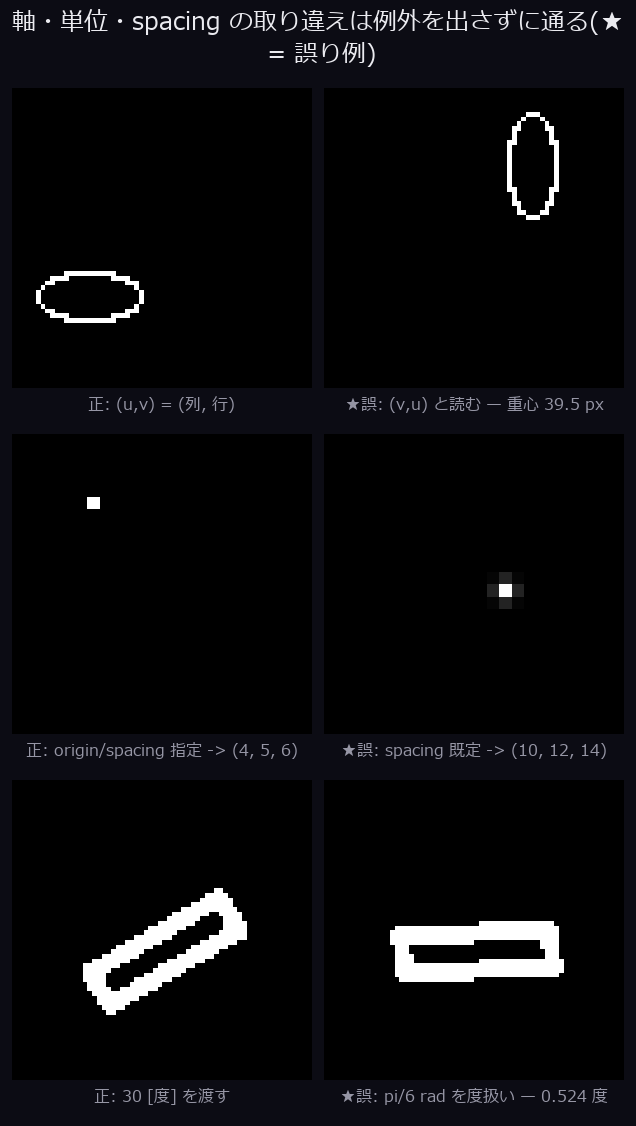
↑ Axis, unit and spacing mix-ups pass without raising — Reading (u,v) as (v,u) shifts the centroid by 39.5 px and drops the overlap with the original to 0.0%; leaving spacing at its default puts the peak at [10, 12, 14] instead of [4, 5, 6]; passing π/6 radians as degrees rotates by 0.5236 degrees; reading the gate as 1 s instead of 1 ms multiplies counts by 1000. None of these raise; all return finite, plausible pictures — which is why the axis is in the op name and the unit is an explicit argument.
- PNG:
docs/articles/assets/wingconv_axis_unit_traps.png(1 frame(s), 636x1126 px, 0.03 MB) - Thumbnail:
docs/articles/assets/wingconv_axis_unit_traps_thumb.jpg - SHA-256:
1a8a74cd5671f2ea3baf3509509f198334d266dc3e94d16de3d28a6672411d61
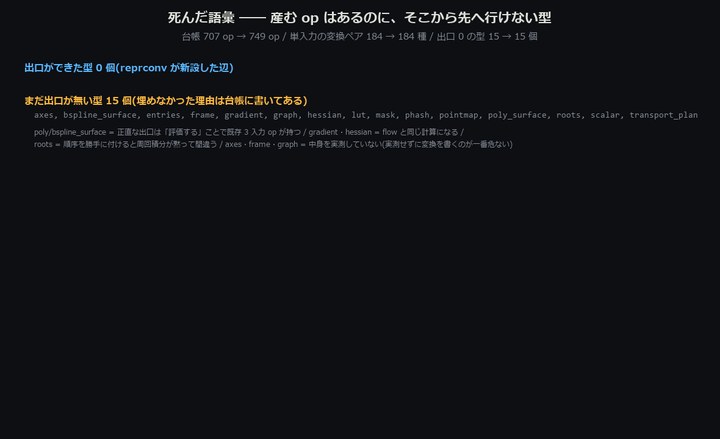
8. Dead vocabulary — types that are produced but lead nowhere
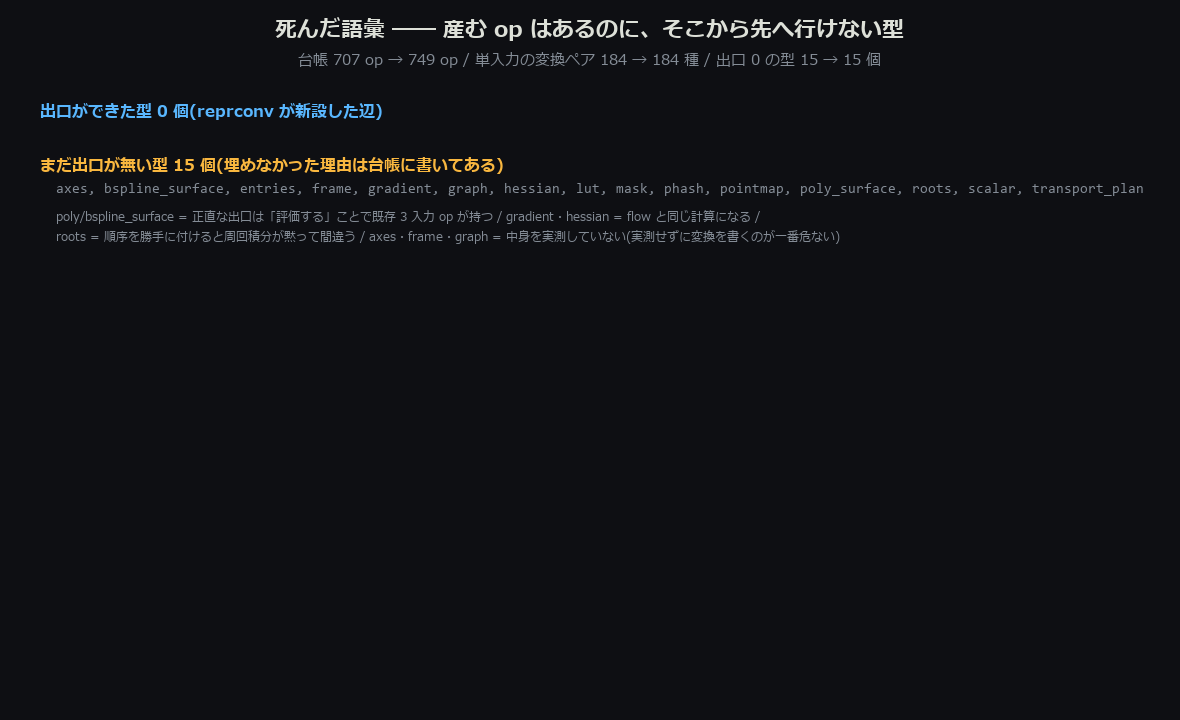
↑ Dead vocabulary — types that are produced but lead nowhere — Counting the 707-op catalogue for ‘single input, in type ≠ out type = a conversion’ found 15 types with no outgoing conversion at all. The 42 ops of reprconv open 0 of them; conversion pairs go 184 → 184 and dead ends 15 → 15. The 9 that remain carry a written reason for not filling them — deciding not to is also a decision.
- PNG:
docs/articles/assets/wingconv_dead_vocabulary.png(1 frame(s), 1180x720 px, 0.06 MB) - Thumbnail:
docs/articles/assets/wingconv_dead_vocabulary_thumb.jpg - SHA-256:
bf69ffebffa729b39bfee9c97190f25010dfd8f557e90d59eaa80b9006848822